On November 15, hacktivist Jeremy Hammond was unjustly sentenced to ten years in prison for, among other actions, hacking confidential emails out of the Austin-based private intelligence firm Stratfor. WikiLeaks published these emails as the Global Intelligence Files. I’ve been researching them intensively for more than a year, and have published two articles on my research at WhoWhatWhy, one on General David Petraeus and one on the Drug Enforcement Administration’s Special Operations Division seeking White House permission to kill Mexican drug lord El Chapo. That second also includes a lot of my research into Stratfor’s informants and clients.
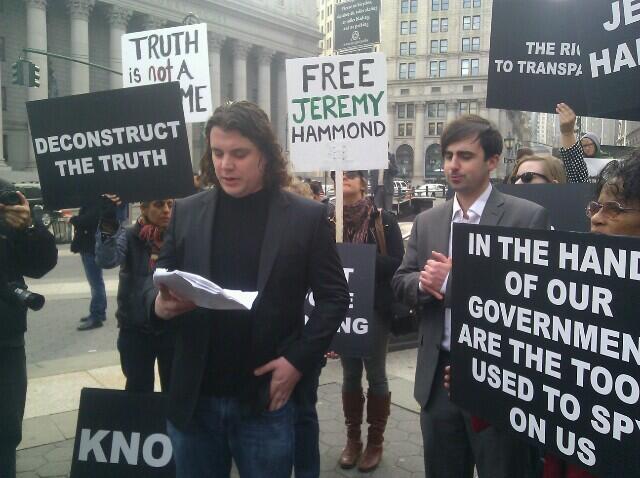
The day of Jeremy’s sentencing hearing, I gave a speech at Foley Square outside the courtroom and some interviews about the value of the Stratfor leak. The leak will continue to benefit researchers for years and years. Journalist Chris Hedges (Wikipedia), journalist Alexa O’Brien (Website, Twitter), and defense attorney Jay Leiderman (Website, Twitter) also spoke at Foley Square.
If you want the short version, check out this interview of me conducted by Jeff Durkin (Twitter) of We Are Change Connecticut (Website, YouTube). It was right after the speech. The interview is about seven minutes long and came out really well.
If you want the long version, here is a video of all four speeches and more by Small Affair (Twitter, Tumblr, Donate, Occupy the Stage). My part is from 36:00 minutes to 49:30. Small Affair also took the picture at the top of this post. Below the video is the prepared text of my speech.
[wposflv src=https://douglaslucas.com/FreeJeremySpeeches.flv previewimage=https://douglaslucas.com/blog/wp-content/uploads/2013/11/DALStratforSpeech.jpg width=400 height=325 title=”Free Jeremy Speeches”]
This morning we saw young but longtime hacker and political activist Jeremy Hammond unjustly sentenced to ten years in prison for, among other actions, hacking confidential emails out of the Austin-based private intelligence firm Stratfor, the leak of which WikiLeaks is now publishing. The five million-plus emails Jeremy provided to us through WikiLeaks span 2004 to 2011 and consist of internal and external correspondence, files, and records of the firm’s analysts, spies, executives, writers, and other employees.
I want to talk for a few minutes about why what Jeremy did has been and will continue be so beneficial to us—that is, I want to talk about the value of the Stratfor leak, which is Jeremy’s contribution to what we can call the historical record or humankind’s knowledge repository or simply just the Internet. For more than a year, I’ve been intensively researching the complete cache of Stratfor documents in WikiLeaks’ possession. I’ve published two in-depth articles at WhoWhatWhy using my research, have a third coming out soon there, and many more in the works.
When WikiLeaks began publishing the Stratfor leak, which it calls the Global Intelligence Files, much of the reaction from the US mainstream media was dismissive. The Atlantic published an article the same day WikiLeaks announced the leak, titled “Stratfor Is a Joke and So Is WikiLeaks for Taking It Seriously.” The Atlantic writer, of course, did not read the five million-plus emails. Rather, he was probably acquainted with Stratfor’s free email newsletter reports and media appearances and was itching to discredit WikiLeaks and its source, who we now know was Jeremy. But what the Atlantic writer was acquainted with was just the surface of Stratfor.
The firm does so much more. In the 2004 to 2011 time span the leak covers, Stratfor provided training and created custom intelligence products—reports, predictions, assessments—for big corporations such as Hunt Oil, National Oilwell Varco, Parker Drilling, Lockheed Martin, Dow Chemical, and for government arms such as the Defense Intelligence Agency, the Department of Homeland Security, the US Marines, and many more. These people weren’t reading the free email newsletter reports. They were buying intelligence products such as Stratfor’s Yemen attack database, in which Stratfor catalogued incidents of violence in Yemen with precise information such as GPS coordinates. They were, in Emerson Electric’s case, paying more than a hundred and fifty thousand dollars a year for phone and email access to Stratfor employees who would brief them on political, economic, and security factors affecting their operations. So much of the information Stratfor was providing these clients is available to us now thanks to Jeremy, and most of it hasn’t been researched yet.
National security journalist Joshua Foust said this week that Stratfor isn’t that much different from a private investigator. P.I.s don’t have the clientele I just listed. They also don’t have Stratfor’s informants, who included Israeli Prime Minister Benjamin Netanyahu, Mexican diplomat Fernando de la Mora Salcedo, and DEA supervisor William F. Dionne, whom I interviewed and who provided Stratfor information off JWICS, a top-secret US government computer network. Much of what these informants were telling Stratfor is available in the leak, again thanks to Jeremy, and most of it, again, hasn’t been researched yet. So we still don’t yet know the full extent of Jeremy’s contribution.
Joshua Foust also said this week that the Stratfor emails “weren’t surprising” for people in the know. That’s false. And he said “weren’t surprising” as if the leak is already over. We’ve barely scratched the surface. The mainstream media in the US doesn’t want to research the information I’ve been describing, they’re not familiar with it, they don’t care. They bash Jeremy’s contribution on the one hand, but on the other hand, the New York Times (as documented by the NYT Examiner), NPR, and other news organizations collaborate or share information with Stratfor behind the scenes. That’s the US mainstream media for you, hypocritical. Turn them off.
There are easily decades’ worth of research remaining for the Stratfor documents. Not only are there more than five million emails, but many of them have PDF attachments of up to hundreds of pages each. Examples of these attachments include intelligence bulletins from the Drug Enforcement Administration’s El Paso Intelligence Center, Texas Department of Public Safety threat assessments and situation reports, and intelligence products created by Department of Homeland Security state fusion centers. There are even intelligence products created by Stratfor competitors whom the firm was studying such as Total Intelligence Solutions, the Institute of Terrorism Research and Response, and Oxford Analytica. So Jeremy didn’t just provide us with information from Stratfor, but also from other private intelligence firms and government intelligence organizations. Again, most of this material hasn’t been researched yet.
But here are some of the greatest hits of what has been uncovered so far.
The previously unknown Trapwire surveillance system was one of the biggest Stratfor revelations. This company with CIA ties developed software for CCTV cameras that identifies or supposedly identifies suspicious behavior and manages and cross-references suspicious behavior reports from different locations and time periods. It also integrates information from license plate readers and other surveillance inputs. Trapwire has been deployed in DC, Seattle, LA, Las Vegas casinos, Atlanta, the London Stock Exchange, and right here in the NYC subways, 500 cameras’ worth according to Stratfor in 2010. If someone “sees something, says something” about you in a New York subway, your “suspicious activity report” possibly goes to TrapWire. Thanks to Jeremy, we better understand mass surveillance, which is crucial, because giving the people who brought us mass incarceration, more than two million people behind bars in the US, the technology to incriminate anyone, whether rival politicians or ordinary citizens, is obviously an immense threat to freedom.
My work at WhoWhatWhy on the Stratfor documents, thanks to Jeremy, includes an article about General David Petraeus, whom Stratfor shows was probably having an extramarital affair prior to previously known, which besides possibly being a military offense, suggests his mistress Paula Broadwell, who was an intelligence officer, may have had him in her crosshairs for a long time. That makes more sense of Petraeus’s downfall from the CIA and gives a better picture of internal government struggles. Another article of mine is on the Drug Enforcement Administration’s Special Operations Division seeking White House permission to assassinate Mexican drug lords. That’s a picture of the increasing militarization of law enforcement and the possible broadening of US assassination policy to merge the war on drugs with the war on terror–a push for a so-called “narcoterrorism” policy. Later this month WhoWhatWhy will publish another Stratfor article of mine of Mexican military presence in the US and US military presence in Mexico. Thanks, Jeremy.
Another contribution of his are the revelations in the media outlet Narco News about the US and Mexican governments easing the path for certain cartels to traffic drugs into the country. Instead of improving the Mexican economy so poor people don’t join cartels or legalizing drugs, the US and Mexican governments pick favorites among drug cartels in hopes that a preferred balance of power among them will reduce the drug war violence. Meanwhile they arrest people for smoking pot. This is a picture of what the drug war really is. And I’ve seen in my research that even Congresspeople are listening to Stratfor on so-called narcoterrorism issues.
Thanks to Jeremy, we learned private intelligence was looking for connections between Alexa O’Brien’s campaign finance reform group US Day of Rage and Islamic fundamentalism, which of course carries the threat of Alexa being smeared as a terrorist. That particular Stratfor memo was cited in her and Chris Hedges’ court case against indefinite detention that went to the Supreme Court. We also learned thanks to Jeremy that the Department of Justice has a sealed indictment against Julian Assange of WikiLeaks, indicating the severity of the US government’s efforts against journalists and the Internet. This revelation was cited by Assange in an affidavit to Swedish police.
There are plenty of other revelations in the Stratfor documents. Those are just some of the greatest hits. You can get involved researching the Stratfor documents yourself. Look them up on the WikiLeaks website, where there is a search engine to look through them.
You might say, Okay, so we grabbed a few headlines, and maybe a few legal documents benefitted, but what’s the use, what does it all add up to? We know Jeremy’s legal case was unjust. The FBI knew Stratfor was being hacked for weeks and did not stop it, and entrapped Jeremy through their informant Sabu. Judge Preska denied Jeremy bail wrongfully. And the sentencing is irrational: if Jeremy had broken into the Stratfor building in Austin and walked off with hard drives, he might have a prison sentence of only about a year. There were other actions he did, but since the US government is cracking down on the Internet and journalists and their sources, he’s stuck with a much more severe sentence. So now he’s in prison. Are the news headlines, past and future, worth that? He says so, but are they really?
Yes. For one, these revelations are examples of why more and more people are ceasing to take the US government and traditional politics seriously. The fewer people trust in the Democratic Party, the better. People who grow disgusted with the System as a result of revelations such as these will begin to look to themselves and solidarity for solutions. Solutions such as the commons or mutual aid. Instead of trying to reform or overthrow the government, we can simply practice governance. Internet technology is a tool that makes mass collaboration for mass self-govenance possible, which is something Heather Marsh writes about, if you know her work. If not, read it.
The best way to look at what Jeremy did is to see it as a permanent contribution to humankind’s knowledge base, our knowledge base, the Internet. Think about checking your phone to look something up. We all know what it’s like to look something up online and find an answer, and we all know what it’s like to feel grateful when we find an especially good answer. That’s the sort of gratitude we should feel toward Jeremy. He improved our knowledge; he’s given us better answers, and they are answers about some of the most important things: what the powers who try to control us are doing. With better information, we can make better decisions and govern our own lives.
Fundamentally, Stratfor is a profit-driven business. It influences big business, government, and the media. It’s an organ of the powerful, but despite its power over all our lives, Stratfor’s employees are not vetted by the people and it’s not open to Freedom of Information Act requests. The knowledge it held between 2004 and 2011 was locked up behind closed doors.
But Jeremy freed it. For that, journalists owe him hard work researching the Stratfor documents, and we all owe him our thanks.
That evening, Vivien Weisman (Twitter) interviewed me about Barrett Brown and my Stratfor research to include in her upcoming documentary The Reality Wars, which is about hacktivists.
Also that evening, I was interviewed on Lorax Live (Website, AnonOps Radio, Twitter, Facebook) about the value of the Stratfor leak. The audio is not online yet, but I will update this page when it is.
Googling “how to reduce the need for affection” doesn’t turn up all that much, and if you ask your friends, they’re just gonna laugh at you. Until weeks later, after they’ve been ditched by whomever it was for them that month, and they come to you, tail between legs, asking “Hey…did you ever find out how to reduce the need for affection?” This has happened to me multiple times!
In researching reducing the need for affection, I’ve come across plenty of articles that try to dodge the issue by avoiding the word “affection.” They claim people are seeking “attention” or “prestige” or “approval” or some other medical-sounding reward. But I think the situation is a lot hotter than that, and by hot I mean a warm fuzzy HUG — get your mind out of the gutter.
A lot of the search results you DO get (YGMV*) are content-farm articles on how to spay or neuter your pet (…so that’s what they’re calling it now?) or y so srs/pitiful pieces in the Huffington Post about how to make your man show you more affection (…she really hasn’t figured that out yet?). I lost the very few useful links I came across. But here’s what I’ve discovered:
Get busy working on an idealistic project(s).
Get a pet (this is more of a hack: route around humans).
Get lost. Aloneness becomes a more comfortable habit given time.
And keep in mind this Theodore Sturgeon quote from his novel Godbody, which the character Britt Svenglund ascribes to the character Dan Currier: “any person who cannot be by himself, it’s because when he is by himself he thinks he is not in good company.”
In the last year, I’ve been in a totally unprecedented situation: I’ve had lots of friends! And I’ve conducted a lot of socializing. (Mostly at this excellent coffeehouse & computer repair shop in Fort Worth.) The whole experience startled me. “Wow, so this is what all the people I hated in high school were doing!” It gets so thoroughly, disgustingly addictive. You wake up one day, and your emotions are beseeching the universe to deliver you affection from others. Your long-lasting contributions to humanity? Yeah, screw those. WAIT NO!
You have to consciously pull yourself away if you get addicted. (Twitter, I’m looking at you.)
Now, you might not want to become a recluse. Currently you gotta interact with people to get where you want to go in life, and it turns out social skills are useful for that. Plus, a good social space generates good random. You encounter people who give you knowledge and paying gigs and culture. This happens in cyberspace, too, but it happens differently in meatspace; I’m not sure how to describe the difference, or why both are valuable.
Brain in a Vat Doesn’t Need Your Meatspace (Pic stolen from here).
A pickup artist is going to look at people with alleged affection-deficits and offer to teach them how to acquire more affection. Which, when you think about it, is not unlike a nicer (or at least nicer-sounding) Thrasymachus, who (according to Plato) taught that justice is nothing but “the advantage of the stronger.” (In the fifth century BCE, in ancient Greece, you could buy teachings from sophists such as Thrasymachus. Early-day Tony Robbins.) Pickup artists have a term: One-itis. Urban Dictionary as usual has the best definition:
Often confused with love, this is the feeling that a particular woman is actually special. This is just an illusion; she is the same as the other three or so billion. “Go fuck ten other women” is the most commonly prescribed treatment for this “disease” (hence the “itis”), as it tends to show quite quickly how very alike people are.
But everyone is a special snowflake, dammit (srsly, you are. And aren’t at the same time, too. Paradox WOAH!). Anyway, it is just remarkable, the difference in perspective, when faced with the question: “What do I do about my affection-deficit?” 1) Become more skilled at manipulating people into giving you affection; or 2) Reduce the need for affection. I’ll take option 2.
Not so fast, the psychiatrists are here. They describe “the self-effacing solution” of wanting too much affection, and the resignation solution of (among others) schizotypals wherein you want too little. Oh, good, the psychiatrists left. Continuing on.
Once I was chatting online with someone, importuning the person for attention affection, and found myself rebuffed; instantly my mind generated epic narratives about how they were full of shit and one day, despite my anger and bitterness, I would triumph before all! AT THE EXACT SAME TIME in another chat window someone was importuning me for attention affection, all plaintive, and I was like, geez, this person’s annoying, won’t they go away, like srsly. Humans are up to here in this affection-acquiring attention-economy business. It’s the pits.
So you want the golden mean of affection and social interaction that suits your purposes and not the purposes your addictions or inexperience define for you. (A golden mean is not necessarily in the middle of the continuum, and not necessarily any sort of average.) On the other hand, maybe you’re such an awesome mystic that you flat-out don’t need to interact with others at all. In which case … can we meet?
INTERLUDE. Let’s take a break for a second.
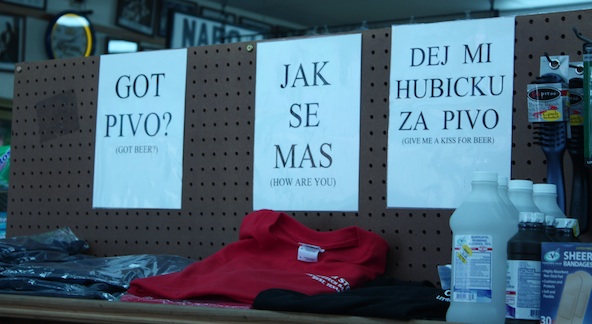
* YGMV: Your Google May Vary, depending of factors such as your IP address. Which is one reason why proxy networks such as Tor are fun: “Today I’m gonna Google from the point of view of someone in the Czech Republic. Podívejte!“
Writing this I found out there’s a now-defunct Swedish goth metal band called Beseech.
They appear not to want my affection…but is it a reverse psychology trick?
Beseech covered ABBA’s “Gimme! Gimme! Gimme! (A Man After Midnight)” which is both awesome and horrible, and most fitting for this post.
Half past twelve / And I’m watching the late show in my flat all alone / How I hate to spend the evening on my own! … [Yeah I can’t take any more of this either.]
END INTERLUDE. Back to srs bizns.
I should point out that killing a social addiction is most conducive to creative thought. Which is much more useful to the world and (less important) much more happiness-producing than nightlife. What other people think really gets into you and mucks with your invention wellspring. Of course, not so good to invent something without people in it, so at least say hi to somebody today, okay? Or maybe just this week. (Even if just online ;-)
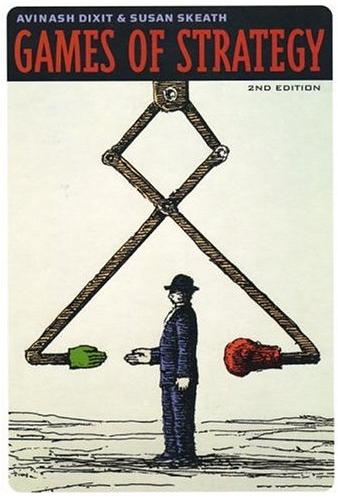
A lot of people I’ve recently met center their lives around winning games, with scoring casual sex encounters as one of the main ones. In this Interview with Pickup Artist Chaser Clarisse Thorn, the interviewer, whom the answer-ready Clarisse just barrels over, splashing her slang about One-itis and strategic ambiguity and outcome independence, asks: “Must everything be framed in terms of a game? What if […] You want to opt-out of that worldview?”
Clarisse answers by saying everyone’s playing games regardless of whatever nobility they affect.
Protester nobly not playing a game; opting-out or super-rational opting in?
One guy I know who regards himself as a skilled pick-up artist (or, as their lingo has it, a PUA) denigrated a certain other person who likes to read books in public by saying the person reads books in public for the sake of appearing broody to women. Maybe the reader just likes to read books. Anyway, the guy writes off men who do not optimize for the degree of social success he regards as advisable by saying these broody idealists have lost so many social games that now they’re just bitter. (As if bitterness alone is damning.) That’s often partly true, I believe, but by not thinking further he’s foreclosing himself from understanding a dimension of human experience that for him just isn’t salient.
I think practicing idealists — let’s say good artists and whistleblowers for specificity — share something: they intentionally lose games in order to create new realities. Think about whistleblower and soldier Joe Darby who exposed the abuses at Abu Ghraib — which included the gruesome CIA-assisted murder of “ghost prisoner” Manadel al-Jamdi. As recounted in Phil Zimbardo’s excellent book The Lucifer Effect (p.476-77), Darby said the abuse he witnessed
“just didn’t sit right with me. I couldn’t stop thinking about it. After about three days, I made a decision to turn the pictures in. You have to understand: I’m not the kind of guy to rat somebody out….But this crossed the line to me. I had the choice between what I knew was morally right and my loyalty to other soldiers. I couldn’t have it both ways.”
After retaliation by Secretary of Defense Donald Rumsfeld, Darby “was whisked away, and eventually concealed in military protective custody for the next several years.”
“But I don’t regret any of it,” Darby said recently. “I made my peace with the decision before I turned the pictures in. I knew that if people found out that it was me, I wouldn’t be liked.”
“For many,” Zimbardo writes, “Darby’s calling attention to the abuses was unpatriotic, un-American, and even faintly treasonous. ‘Hero a Two-Timing Rat,’ ran a headline in the New York Post. [… Darby] was unable to accept [a Presidential Citation honor from the American Psychological Association] because he, his wife, and his mother had to remain in military protective custody for several years in the wake of the many retaliation threats they received.”
The game, the incentives lined up for Darby did not offer him victory for whistleblowing. He decided it was more important to create a new reality wherein injustice at Abu Ghraib had a better chance of being righted. These are the kind of people, I think, that pickup artists write off as merely being bitter. (Note the mainstream media’s dogged efforts to reduce idealist Bradley Manning’s motives to social frustration.)
Another guy I know defended Joe Paterno for not doing enough about the Penn State child sex abuse scandal. This guy said Paterno was being paid well, and when you are being paid well, you can’t be expected to risk things; he also said it with a wink wink, nudge nudge attitude that conveyed “Mature people in the know agree with me.” He is a popular, cheerful young man who is solidly liberal, solidly Democrat. His attitude that maturity consists in surrendering ideals belongs to the feel-good pickup artistry of political and social marketing: Romney’s RNC speech, Obama’s speeches, The Daily Show, TED Talks. The content is irrelevant here; the truth or falsehood or the value of a particular Daily Show joke or Romney claim is irrelevant here. What I am saying is that the way marketers prioritize making the audience feel good higher than the content is most dangerous. We have a world where marketing and appearance trump reality and truth-telling to such an extent that anyone who prefers the latter over the former is cast off as immature and bitter before they are even listened to. But how are you supposed to report CIA torture? With a laughtrack?
Good artists work the same way, though not in the conscious decision-making manner of whistleblowers. By a sort of instinct, good artists wind up rejecting the incentives the main of the art market offers them and create not ossified things but new and therefore real things. New realities. Creative writing is good to the extent that writers allow themselves to live fully while writing; that reality pays off in the voice or tone of the piece, which reminds readers not to trust in appearance but rather in reality. Somebody might be reading a book in public to remind himself of that.
You could ask, though — what is the difference between perception-management (a negative term for a component of marketing: managing consumer or voter perceptions) and putting your best foot forward? After all, many of the techniques pickup artists teach are useful social skills to learn, just amped up and repurposed for sexual conquest. And though the horizon for contributing to humanity anonymously (seethese to learn more) is improving, people pretty much still need to interact with others to get where they want to go.
When you put your best foot forward, you are primarily allowing people to perceive you of their own accord, rather than emphasizing your manipulation of consumer and voter perceptions. I say emphasize because of course people are always managing perceptions by picking out what outfit they want to look good in today, etc. But it is when appearance overtakes reality that you have a problem. Especially if you can no longer tell the difference between the two. The phenomenological difference between them in first-person experience is real, I think. I’m not entirely sure. More than one slightly ashamed person in a private moment has asked me how they can make themselves more authentic. Maybe I am bitter, but I never know how to answer that question, because it is a problem I’ve never really had.
Guru.com is a website that serves as a middleman for freelancers and people wanting to hire them. About a month ago I noticed this ad:
Title: Political Rant I
Project ID: 820169
Budget: Not Sure/Confidential
Category: Writing, Editing & Translation
Description: Looking for freelance writers to produce humorous/sarcastic in nature rants (mostly political in nature) at the demand of the client. Clients will provide the subject material or target of the rant. What we would like to see is an ability to use the facts to make your point in a humorous/sarcastic fashion within a quarter page our less (not interested in character assassination). We are a start-up web base business offering a unique form of stress relief to the politically frustrated. We would eventually like to have three (3) writers work represented on our site for clients to choose from. All interested individuals should provide a location where your work maybe viewed, injection of humor is a must and please include pricing. This is a start up and we do not have an open date but are aggressively working to establish one.
Ad was placed by some outfit (not sure who) apparently based in Cedar Park, Texas. It received 26 proposals from freelancers.
My good friend CynthiaShearer said something in a long-ago (long-ago in net years) blog post, a review of Richard Yates’ novel Revolutionary Road, that has puzzled me for a while. Before I get all critical of a single phrase in her post, lemme say some positive stuff to block any negative feelings.
Her blog post’s awesome.
Cynthia’s awesome and her blog’s awesome.
Revolutionary Road and Richard Yates are awesome.
Thanks to Cynthia’s review, Wifely and I both read the novel, and we found it so worthwhile, the book has since become something of a touchstone in some of our conversations.
Now with the kindnesses out of the way, here’s my quarrel, or really, quibble jumping-off point. In the course of otherwise spot-on praise for Yates’ novel, Cynthia gives the following as a thought on the book:
The novel is flawlessly structured, three acts, and eminently filmable.
Confirming what I thought, my OS X dictionary gives the following definition for “eminently”:
used to emphasize the presence of a positive quality
Maybe Cynthia wasn’t using the word so specifically, but regardless of authorial intent…and setting aside commerce, writers upping their audience — i.e., considering aesthetics alone — why is it a positive (or a negative) quality for a book to be filmable? We don’t say: “That’s a great sculpture; after all, it’d make a fantastic piece of photography” or “That’s a great painting; after all, it’d make an excellent symphonic work.”
Connections between artistic content remixed into another art form can be worth pursuing and elaborating and evaluating, but I don’t see any basis for using as a criterion of aesthetic appraisal the ease with which an artistic piece can be remixed to another art form.
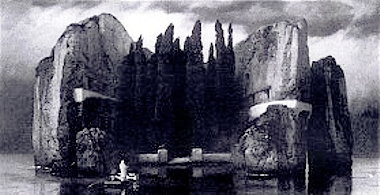
By the way, one of my favorite remixes of artistic subjects is Rachmaninoff’s symphonic poem Isle of the Dead Op. 29, composed in the early 20th century and then recorded with Rachmaninoff himself conducting. And yes, it’s “beginner’s classical,” shut up. Arnold Böcklin’s painting Isle of the Dead inspired Rachmaninoff’s piece — apparently the black-and-white version:
Here’s the color version:
And the music, low-fi and split into two parts due to copyright and YouTube limitations:
Anyway, the (wrongheaded!) idea of using as a criterion of qualitative judgment an artwork’s capability to be transformed from one art form to another got me to thinking: what can a novel do that no other art form can do? The closest (non-textual) art forms are probably plays (in performance) and movies (“movies,” not “films”; I don’t screen films, I watch movies). What can novels do that those art forms can’t do? I’ll not consider plays, as I haven’t thought much about them. So: movies.
In my tentative answers I’m going to put aside style, too, since sentence-level quality, I think, is a) not obligatory for a novel to be good, and b) not inherently novelistic. So, my first tentative answer: maybe novels can represent time, the workings of memory, changing perspectives, and the inner experience of emotions and thoughts better than any other form. As an example of what I mean (UPDATE: screenhead.com’s list of the hardest novels to film), Theodore Sturgeon’s excellent short story The Man Who Lost the Sea (legal full text at link) — warning, spoiler in the third quoted paragraph:
Say you’re a kid, and one dark night you’re running along the cold sand with this helicopter in your hand, saying very fast witchy-witchy-witchy. You pass the sick man and he wants you to shove off with that thing. Maybe he thinks you’re too old to play with toys. So you squat next to him in the sand and tell him it isn’t a toy, it’s a model. You tell him look here, here’s something most people don’t know about helicopters. You take a blade of the rotor in your fingers and show him how it can move in the hub, up and down a little, back and forth a little, and twist a little, to change pitch. You start to tell him how this flexibility does away with the gyroscopic effect, but he won’t listen. He doesn’t want to think about flying, about helicopters, or about you, and he most especially does not want explanations about anything by anybody. Not now. Now, he wants to think about the sea. So you go away. […]
His head isn’t working right. But he knows clearly that it isn’t working right, which is a strange thing that happens to people in shock sometimes. Say you were that kid, you could say how it was, because once you woke up lying in the gym office in high school and asked what had happened. They explained how you tried something on the parallel bars and fell on your head. You understood exactly, though you couldn’t remember falling. Then a minute later you asked again what had happened and they told you. You understood it. And a minute later . . . forty-one times they told you, and you understood. It was just that no matter how many times they pushed it into your head, it wouldn’t stick there; but all the while you knew that your head would start working again in time. And in time it did. . . . Of course, if you were that kid, always explaining things to people and to yourself, you wouldn’t want to bother the sick man with it now. […]
Say you were that kid: say, instead, at last, that you are the sick man, for they are the same; surely then you can understand why of all things, even while shattered, shocked, sick with radiation calculated (leaving) radiation computed (arriving) and radiation past all bearing (lying in the wreckage of Delta) you would want to think of the sea. For no farmer who fingers the soil with love and knowledge, no poet who sings of it, artist, contractor, engineer, even child bursting into tears at the inexpressible beauty of a field of daffodils—none of these is as intimate with Earth as those who live on, live with, breathe and drift in its seas. So of these things you must think; with these you must dwell until you are less sick and more ready to face the truth.
(Oddly for a science fiction story originally published in a straight-up “genre” magazine — The Magazine of Fantasy & Science Fiction — “The Man Who Lost the Sea” was selected for the 1960 edition of The Best American Short Stories.)
I’m not sure a play or a movie could represent the Sturgeon story, its workings of time, memory, changing perspectives, and inner experience as well and as concisely — or even at all. But that’s a huge disjunction: are plays and movies able to represent the Sturgeon story — just not concisely or well — or is there something inherent to the story that cannot be translated to another art form? I think that depends on how inherent an aspect of an artwork has to be for it to be considered inherent. ;-) And, how good does the movie have to be? The movie could voice-over or crawl tons of text to get closer to the original fiction format, but that (probably) would become annoying. You never know, however; artists are always figuring out new techniques. All the same, because representing time, memory, changing perspectives, and inner experience is at least a huge strength of fiction (and especially the novel), more and more I try to emphasize those qualities in my own writing.
I said first tentative answer, so how about this second one, which I can describe best in a metaphorical way? Novels are like multicharacter, revised, organized daydreams — or, imagine being a kid and playing with dolls or figurines, making up stories. That’s basically what novels are, I think, but not so much created daydreams worlds as the daydream-y experience of personal identity as a network of multiple narratives, comprised of images, emotions, etc., and stuck into the context of particular settings and social histories/influences and so forth. Sorta sounds like Bakhtin’s account of polyphony in Dostoevsky. But I haven’t read enough Bakhtin yet to say much; besides, his name sounds like Bactine.
Please don’t DMCA-takedown me, Bayer
This way of looking at what’s unique to novelistic form doesn’t seem to strongly entail the memory rumination or time aspects or changing perspectives I mentioned earlier, but yeah, I think fiction — especially when it avoids too much exposition and abstraction — stages a vehicle for experiencing a daydream related to identity and traveling in a specific historical or social context. Yet in “When Narrative Fails,” an article in May 2004’s Philosophy, Psychiatry, & Psychology, J. Melvin Woody makes an interesting case that other forms of art can do this, too:
“Why […] should we limit our understanding of the constitution of the self to the narrative? Indeed, why limit ourselves to language? Do not music and dance often articulate our passions more eloquently than any literary form?”
Nevertheless I think my second answer is pretty strong, and pertinent to why reading fiction is not just another hobby or preference, but something people who have the ability and resources and time to read it really should do so.
If you aren’t up to speed on Wikileaks news, try here and here and here, and watch this:
Now that you’re up to speed:
There is this goofy card game one of my brothers likes to play; to my knowledge, he invented it. The dealer (typically my brother!) passes out one face-down card to himself and one to each other player. At his signal, all players raise their cards to their foreheads facing out such that no one can see his or her own card, but everyone can see everybody else’s. The players then place bets as to how valuable they think their own cards are in comparison — a total guess, of course, but by this time everyone’s laughing from holding poker cards against their skin. After betting, the players reveal their cards, and the random results release laughter …
Here’s my version of the game, which so far exists only in my imagination. People find themselves seated at a dinner table, clutching their one card tightly to their chests, looking down at their stated worth — “7” or “3” or “10” — a value that is calculated according to all the good and the bad they have caused in life, according to all the secrets they know, according to all the things they wish they hadn’t said or they wish they knew how to say.
At this imaginary table of mine the players are making small talk, some of it happy, some of it sad; all are nervous about their value, and what the other players would think if their card were seen. After all, this player Sue’s card reveals that she said to this player Bob that this other, wealthy player Jorge’s a jerk, and now that Bob and Jorge are pretty good friends, does Jorge know what Sue once said about him, and if so, how does that affect who’s gonna pick up the check?
The dealer — a voice from the sky? — suggests the players lay their cards down on the table, face-up, on condition that they all, unanimously, forgive one another and love one another regardless of the cards’ value. The players agree, make their promises, and lay the cards down face-up. Angry yelling (“Jorge has the hots for both Bob and Sue?”) soon turns to laughter (“Jorge has the hots for both Bob and Sue!”) as people discover everyone’s a mess inside …
Except what if the players at the table included polarizing figures such as (take your pick) Dick Cheney, Barack Obama, Julian Assange, or heck, even that driver yesterday who cut you off when you really needed to get over a lane? Would we the powers-that-aint agree to forgive they the powers-that-be permanently if they’d lay down their cards and their guns?
I would. I would, to get the cards on the table so everyone could be safe.
There are of course several things my card-game scenario doesn’t address. For instance, it seems radical transparency and privacy can come into conflict, and privacy is I presume often preferable: if you’re surveilled to death, your creativity is chilled (partly because honest creativity requires engaging in thoughtcrime) and also under surveillance you can’t experience as fully the fun premium privacy can add to events (e.g., sweet nothings can be more meaningful when expressed without others around). Further, logically there are possible worlds where security is unjustly threatened by radical transparency, and I am uncertain as to how such situations, when they do arise in this actual world, should be handled, although I am tempted to say, well, let the chips cards fall where they may, because 4000 years of trading our rights away to leaders whose trustworthiness is unproven in return for promises of security hasn’t worked out so well.
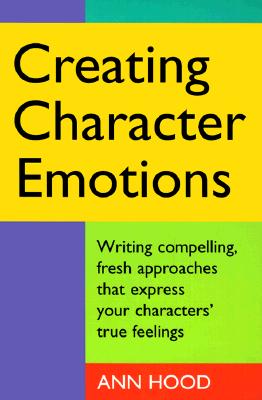
Most how-to fiction-writing books I’ve read — and I’ve read a bunch — are bad, worse, or useless. A few have helped me tremendously, however, and they don’t fall in either the pathetic HOW TO WRITE A BESTSELLING NOVEL category (an actual title!) or in the John Gardner “Does anyone actually read this?” category. The three I’m thinking of lie in the Woah, this is useful! category that makes it worthwhile to occasionally visit that slightly embarrassing WRITING REFERENCE section of the bookstore.
After opening with an essay on writing about emotion, the book gives 36 short chapters, each focusing on a separate emotion — Anger; Anxiety; Apathy; Confusion; etc. — in a specific pattern: a short essay discussing the particular feeling, bad examples of its description in fiction (with discussion), good examples (with discussion), and exercises. (Myself, I always ignore exercises; I have enough writing projects of my own! So I can’t speak for or against her exercises.)
Here’s ANXIETY.
Excerpt of the first part, the mini-essay:
Anxiety comes from matters large and small. Anxiety is worrying to an extreme.
Excerpt of the second part, the bad examples:
“Would that doctor ever come out? Jon wondered. He bit his nails and tapped his foot nervously.” […] Nail biting, foot tapping, fingers drumming, sweaty palms, butterflies in the stomach, a trickle of sweat, and pacing are all tired ways to show anxiety.
Third excerpt, one of the good examples (from Thom Jones‘s short story “I Want to Live!”:
“But those people in the hospital rooms, gray and dying, that was her. Could such a thing be possible? To die? Really? Yes, at some point she guessed you did die. But her? Now? So soon? With so little time to get used to the idea?”
Fourth, one of the exercises:
Choose a seemingly minor reason to produce anxiety, such as an invitation to a party, running out of hot water, a rainy day, and write a one-page scene in which a character obsesses on that concern. Be sure the character’s anxiety level rises as the scene progresses. Objective: To tap into the heart of anxiety. Even a small thing can cause great panic.
Too often I see in fiction the “He bit his nails”-type shortcut to expressing emotion — in fact, I don’t think these shortcuts express emotion at all, except for inexperienced readers or for characters with really important nails (what about biting the kind of nails you put into walls?). I think those shortcuts — “He bit his nails” — are, unless the writer’s really trying to speed a paragraph along or some such, simply announcements to readers’ left brains (so to speak) that amount to “Oh, the story is informing me that this character is anxious.” The shortcuts become mere info to process, sort of like a bus route chart: no emotion there.
Whereas a description of anxiety that startles or wounds or points uniquely will force readers out of complacency and keep them engaged in reading which is an active process of creating an experience in the mind. The Thom Jones example above makes readers (me at least) worry about suddenly learning of their own impending deaths. The bad example is just data, better suited to a computer than a person. CAVEAT SCRIPTOR: Don’t ditch all physiological ways of showing emotion, of course, unless you want your characters to represent disembodiment.
By the way, some writers/critiquers subsume the above advice under the precept “Don’t tell readers what to think.” That precept, I think, is imprecise. If a writer says “He wandered the hours away by the bank of a brook, watching the sun on the face of the chuckling water. A bird came to circle him, flew unafraid through the aura of gladness about him. The delicate tip of a wing brushed his wrist with the touch of the first secret kiss from the hands of Bianca” he should first win an award, but anyway, he is, in fact, telling readers what to think — at least to some degree — he’s commanding THINK OF A BIRD; and THINK OF A TIP OF A WING, etc. So drop the precept, people!
Clarion West, the six-week writer’s workshop I attended in 2008 on a space station in geosynchronous orbit above Seattle, hosts an online donation drive called the Write-a-thon each summer concurrent with the in-person workshop (June 20 – July 30). This year I’m participating in the drive along with many other former students and instructors. Here’s the deal: participating writers pledge to complete a certain amount of work individually; their friends, family, and fans donate whatever amount they choose to Clarion West as a show of support for both the writers and the organization. My goal: “Each of the six weeks I’ll either write a complete, good first draft of a new short story, or finish revising an older, in-progress one.”
The donation drive works on an honor system — but, if you want proof I actually meet my Write-a-thon goals, I’m happy to accommodate you privately pretty much however you see fit. And, no promises, but if you do donate and want a character named after you in one of the stories, let me know that, too, as long as your name isn’t Forrest Gump or Darth Vader; if your name is euphonious I’ll ask the Muse to see if It can work anything out.
Clarion West is a nonprofit organization, and in the United States donations there are tax-deductible, as described on the main Write-a-thon webpage. Remember the organization has to fly the space station, pay the instructors, and so on — a lot goes into making this wonderful workshop happen. Rest assured that it is totally, totally, totally acceptable to donate a mere $5 if you want; $5 times a lot of donors times a lot of writers equals a whole lot of money.
To donate, you can either 1) click the PayPal “Donate” button on my personal Write-a-thon profile page, or 2) send with a note mentioning my name a snail-mail check to:
Clarion West
P.O. Box 31264
Seattle, WA 98103-1264
Thanks everyone, and I really appreciate even a single $5 donation to Clarion West. Let me know if you donate: it’ll make me work harder! Feel free to badger me about my progress towards my Write-a-thon goals, too!
As mentioned before, Clarion West is stationed in geosynchronous orbit above Seattle, but at the same time it replicates the Earthly city below. I think this Miévillean metaphysic serves in part to shield Clarionites’ dubious deeds from those who might not understand what happens when writing workshops (rightfully) push people to revise their stories: their fictional stories and moreso their personal identity ones. In the space station, as narratology becomes conscious craft, students confront fictional characters who battle through fictional plots, and confront seventeen other writers, plus a vaunted instructor, each of whom are battling through their personal plots — and everyone winds up using the manuscripts as materiel.
Mortal Kombat II: SNES
With their laptops students type out art, trails to their selves; the art becomes in the classroom terrain for proxy wars over personal identities — and over the group’s identity, too. Everyone in the building is at once enemy and comrade. Reality shows would pay to sell some of the behavior that bubbles up. Caught in it, students lean on each other for support. That requires privacy; thus the mystery of the workshop’s location. Again: the experience requires privacy. To have four laptops — writers’ trusted weapons — stolen by aliens breaking in … an invasion!
I’m not clear on the actual details of the heist, none of us were, though we scried far and wide for the aliens, and sent many spaceships chasing after. We were all as one laptop-less ragtags, but within forty-eight hours we were high-fiving each other — because to our quick rescue came an advocate of privacy shielded with a sheen of transparency, in other words, that frenetic pirate known as Cory Doctorow.
Info he finds useful he boomerangs, and so when he learned aliens invaded just prior to his arrival, he donated his instructor’s pay toward laptop replacements and posted the following on Boing Boing:
Clarion West, the famed Seattle science fiction workshop, has suffered a terrible theft: four student laptops were stolen yesterday. Clarion West (like Clarion in San Diego) is a grueling, six-week intensive boot-camp for science fiction writers. Students often quit their jobs and save for years to attend and it goes without saying that they can hardly absorb the cost of a new laptop in the middle of the workshop.
I’m flying to Seattle tomorrow to teach the third week of the workshop and I’m keenly aware of the chaos this will have wrought on the students. The workshop’s organizers are soliciting donations — either hardware or cash — to get the students up and running. The workshop is incorporated as a 501(c)3 charity, so any donations are tax deductible.
I am donating all of my teaching fee to the fund. I hope that some of you will be moved to chip in whatever you can afford, to help fund the instruction of the next generation of great science fiction writers.
Clarion West received enough donations to replace all stolen laptops. I wonder which literary fiction communities could boast the same (I’m actually asking!).
That week, in addition to the invasion, I was shaken “as if with ague,” which is the writerly cliche for describing someone tremoring.
Except there was no as-if subjunctive for me: all week I had a constant fever registering over a hundred, and I had a cough, too. I think the illness was brought on by too much exercise (I ran in the mornings). Thankfully the administrators (Neile Graham and Les Howle) gave me nothing but the kindest help. My memories of Cory’s week, though, remain hazy.
All the same he had a sensitivity about him that I don’t see many mention. For example, he was the only instructor who in the one-on-one sessions made a point of asking how we were doing emotionally, aside from the writing portion of the workshop; that thoughtfulness probably was in part due to his having attended Clarion East as a student in 1992. He definitely understood how stressful and transforming the entire experience is, how it requires the privacy and the care that can come with a good group’s special, monastic space (station).
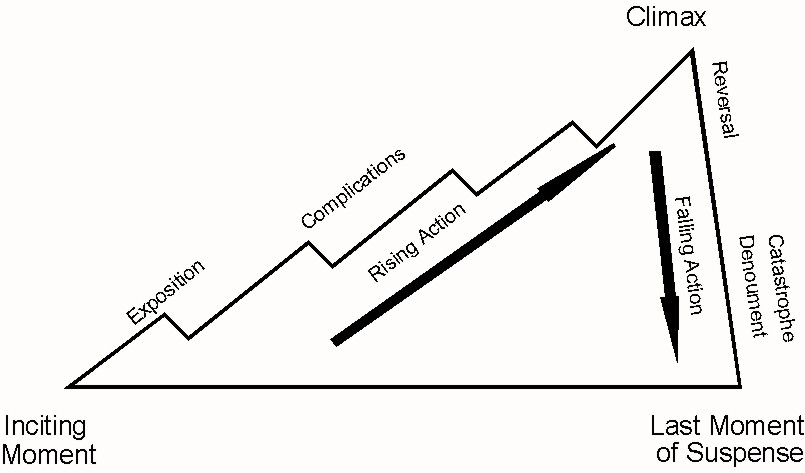
In one lecture Cory gave us a seven-point formula for plotting: create 1) a character 2) in a place 3) with a problem 4) who intelligently overcomes obstacles, 5) and as things get worse, 6) conflict by necessity comes to a climax, 7) after which there’s a denoument.
If I’m not mistaken, Cory portrayed this formula as universal, which with if so I take issue. The formula doesn’t account for certain types of good stories that go under-represented in science fiction & fantasy: stories with unreliable narrators, trapped protagonists who don’t escape into heroic stature — they’re the kind of characters who remind us, as we watch their ironies, of just how much sway our environment has over our lives, and how unreliable information is, no matter how much we try to route around those bugs/features of reality.
As I mentioned in Part 4, most (all?) my classmates in the space station, along with our Week 2 instructor (Mary Rosenblum), totally loved my Week 2 story (“Glenn of Green Gables“); Cory was among the readers who didn’t. Years later I can count the non-fans on one baffled hand. Cory argued Glenn isn’t like-able since he doesn’t solve his problems intelligently. My rejoinder, however unnecessary it is now (people are entitled to their opinions!), is the one a fellow Clarionite suggested: Glenn is an emotionally intelligent problem-solver because he bravely sticks to his lonely love for ol’ Anne Shirley despite increasingly sinking circumstances…
I've never actually read any Green Gables books -- just Googled 'em for allusions
Maybe I seem bitter, and for a time I did feel a bit (byte?) uselessly resentful. But that’s not the point, not me; the point is to tell you (especially future Clarion students) what I experienced. So: there were three male instructors my year, three female. My father is and has been, uh, conspiciously absent from my life, and so the less mature 2008 version of me unconsciously scrutinized Paul Park, Cory, and Chuck Palahniuk in a way he didn’t the three other instructors (Mary, Connie Willis, Sheree R. Thomas). I regarded the men’s instruction as having a sort of paternal absolutism to it.
And so I’m like…
Now that I’m more of an “active protagonist” in my “real” life (thanks in no small part to Clarion West and Seattle), I’ve intentionally challenged myself to write short stories in different and also more traditional ways, and for that, Cory’s obstacle-tackling pointers have proven handy.
…where am I?
One application: while plotting with point 5 — “as things get worse” — I can ask myself, not “what happens next?” but rather “what would raise the stakes?”
But mostly I just keep piracy and capering as tesserae in my own aesthetic.
You want more? Here’s a list of Cory’s excellent fiction-writing advice:
If you don’t like your story, you get stuck more frequently. If you’re stuck, ask yourself what you need in the story to make yourself like it.
Use a feed reader and consider staying on top of interesting things (including current events) part of your writing job. But be willing to “mark all as read” when you get behind; don’t be perfectionistic about it, or you’ll never keep up with anything.
If you’re really stuck, changing projects can be a good strategy.
Write down little bits of things that interest you, and have a good storage system.
Get away from any ceremonial ritual for writing. You will become dependent on the ritual.
Freewriting about whatever is blocking you works well. The shortest path between thought A and thought B, according to some science article or other, is writing it down.
Subjunctive sentence constructions, dreams sequences, telephone conversations, &tc. generally don’t have as much power as showing situations actually happening to characters face-to-face.
When you’re stuck, look back at what you wrote earlier. You’ll often discover or remember stuff you were thinking earlier that you can use to go forward.
Use descriptive filenames if guidelines for electronic submissions ask for attachments.
The central conceit of a story sometimes doesn’t even show up until a story has gone through multiple drafts. Be willing to revise extensively.
You stop having writer’s block when writing becomes your job.
The interview and photo-shoot experiences were really fun. I’m glad people are paying attention to local artists during a time when not many are. DFW.com is a fun site — you should check it out anyway; my girlfriend Kate and I found a really cool hangout, Gallery Art Cafe, through DFW.com’s highly searchable directory of local restaurants.
I'm a Texas-born, Seattle-based freelance writer/journalist currently living in Chiapas, México. Published at Rolling Stone, Foreign Policy, Salon, WhoWhatWhy, the Texas Observer, the Daily Dot, others. I write about anything and everything, but usually current events meets investigative journalism and philosophy; liberatory mental health; education; science fiction and fantasy; technology; justice; more. Also a former public ed substitute teacher.
Email: DAL@RISEUP.NET (ask for pgp key or check keyservers if you want encryption)
Snailmail (United States Postal Service only): Douglas Lucas / PO Box 75656 / Seattle WA 98175 / United States
Snailmail (Private carriers such as UPS, Fedex, DHL, Amazon): Douglas Lucas / 11036 8th Ave NE #75656 / Seattle WA 98125 / United States
Note the single-character change in ZIP codes, between the address for USPS (98175) and the address for private carriers (98125), is not a typo.



















 Twitter:
Join the conversation