TL;DR: Here’s my talk as a DRM-free .mp4 and my corrected English subtitles in .srt or .vtt format.Watch below, and the corrected subtitles are already inside the embed, but you’ll probably need to click the three vertical dots at the video’s bottom right and select “Captions” to turn them on (Chrome) or click the [cc] box at the video’s bottom right to toggle them on (Firefox). The subtitles greatly remediate editing errors and also gaps in my speech where I omitted transitions or didn’t make certain logical connections fully explicit. You’ll want to watch with them on. Don’t forget the recommended resource list.Enjoy!
Note: You might also be interested in my Foreign Policy article from two months ago about G, the global commons for public data collaboration. Gift hyperlink; alternate hyperlink.
On Oct. 9, the Hackers on Planet Earth (HOPE) staff made every talk from this summer’s HOPE XV conference in New York City available via their website. Buy them all on a thumbdrive or download individually. I bought just mine and embedded the DRM-free .MP4, meant for sharing, above. It’s also on my youtube. HOPE staff said then that sometime soon, they’ll put this year’s presentations on theirs.
I gave the talk on Friday, July 12 starting at 7 p.m. on the main Marillac Auditorium stage. Sure, there were technical difficulties and I used too many filler words—it was my first time presenting to adults without scripting it all before, and due to life/journactivism exigiencies, I’d prepared the outline just hours prior, meaning no rehearsals or revisions, especially as I was busy writing the 14-page recommended resource list (PDF) that accompanies my presentation, as mentioned in my talk.
But if your goal is to learn from a Survey and Scrutiny of Election Security, the video will meet that need, especially if you employ the corrected subtitles.
The $.99 downloadable from HOPE came with subtitles—English, German, Spanish, French—and the transcript .txt they’re based on. I edited the numerous errors, some at the hands of 2600 (I replaced these), others my own mistakes while speaking [fixed in brackets]. Here’s the corrected transcript and the corrected English subtitles (.srt; .vtt). If anyone wants to translate my corrected version to any language, email me and I’ll add your subtitles to this post for others to peruse.
Much of my talk is simply trying to steer you toward the recommended resource list—your homework, so to speak. That document definitely puts election security and activism knowledge in your hands so you can do something awesome with it—which would make a great story to leave in the comments. In my presentation, I also mention uploading the flowchart to my site; I’ll do that at some future date when I have time and can improve it. For my June post and one-minute video promoting this talk, go here.
Embedded below, the full Biden video I showed on stage during my talk (all 41 seconds). HOPE’s after-the-fact editing removed the audience gasp and shortened Biden’s three kisses to two. Following the full Biden video, a few final notes for my presentation overall, in quick bullet points.
Here are the two RAMRANTS tweet-thread URLs, mentioned in my talk, leading to many more examples of Biden being creepy, mostly C-SPAN footage:
In the Q&A, someone asked about the accuracy of recent U.S. elections. I gave two answers: we need more data, and second, that though former pollster Jonathan Simon’s exit poll forensics show many voting jurisdictions presenting legitimate results, there have also been enough jurisdictions with significant enough disparities between totals and exit polls to raise serious alarm.
A third answer would have been to give a bird’s eye view of the strength and frequency of official audits. These are voting jurisdiction staff doing sort of the same thing Simon is, but drawing on very different data sets, usually spot-checking handmarked paper ballots and comparing those samples with the vote totals, ideally according to Stark risk-limiting audit protocols. If you can see what’s going into a black box and what’s coming out of a black box, and it makes sense against a neutral standard (i.e., spot-checked handmarked paper ballots), then you don’t have to fear, say, the proprietary black box software so much—though people debate that too, particularly if audits aren’t conducted, as they should be, for every single contest regardless of margins of victory.
Here’s what the Senate Intelligence Committee wrote in 2018 in the first volume of their underexamined report on Kremlin election interference in the 2016 U.S. elections: “Statistically sound audits may be the simplest and most direct way to ensure confidence in the integrity of the vote. States should begin to implement audits of election results. Logic and accuracy tests of machines are a common step, but do not speak to the integrity of the actual vote counting. Risk-limiting audits, or some similarly rigorous alternative, are the future of ensuring that votes cast are votes counted. [Unnamed] State 8, State 12, State 21, State 9, State 2, State 16, and others already audit their results, and others are exploring additional pilot programs. However, as of August 2018, five states conducted no post-election audit and 14 states do not do a complete post-election audit. The Committee recognizes states’ concern about the potential cost of such audits and the necessary changes to state laws and procedures; however,the Committee believes the benefit of having a provably accurate vote is worth the cost.”
Verified Voting has a map/visualizer, as of 2022, for post-election audit law and practices. It appears that two years ago—i.e., four years after Senate Intelligence Committee passage above—we had five states carrying out risk-limiting audits, though not always binding or fully comprehensive ones. And we had eight states with no post-election audit law. The remaining states (and setting aside the territories) were somewhere in between: audits, but not the risk-limiting gold standard kind; or audits that were optional, partial, nonbinding, or otherwise deficient …
It’s a hodgepodge mess. The results are likely trustworthy, except where they aren’t; you just can’t trust ’em, except where you really can because of overlapping accountability layers of high-quality audits, statistical forensics, scrutineers, and more. And all of this is in motion every single day. It does seem to be slowly getting better…so the swing state majority who come to consensus for a particular presidential candidate can impose on the rest of the country, and more can feel confident that the destined-to-be-unfair hierarch will enter into the White House above them fairly.
In the video, I mention MAGA’s Stop the Steal lawsuits tanking except for one minor case in Pennsylvania. A great resource on all that is the July 2022 reportLost, Not Stolen: The Conservative Case that Trump Lost and Biden Won the 2020 Presidential Election.
One great thing about Scrutineers.org that I neglected to mention in the talk is that they’re specifically working to bring together—to bridge the gap between—on the one hand, the grassroots, boots-on-the-ground movement activists, often black activists, fighting decades-old voter suppression tactics—which stymie vote capture—with, on the other hand, the academic, cerebral, often white guys who are digging into the proprietary voting computer vulnerabilities, which interfere with the vote tallying side. These two disparate realms really need to come together, as they increasingly have in Coffee County, Georgia, for example.
I mention in the talk that Trump almost certainly owes China substantial money. Here’s my 2021 blog post on that (CTRL+F “China” to jump to the relevant section). Some other information on the topic worth checking out: Jan 2024 report on Chinese-owned or -backed entities spending millions of dollars at Trump’s properties while he was in office, likely a violation of the Constitution’s Foreign Emoluments Clause; in 2016 he described himself as the “king of debt,” saying, “I’ve made a fortune by using debt, and if things don’t work out I renegotiate the debt. I mean, that’s a smart thing, not a stupid thing” and explained, “You go back and you say, ‘Hey guess what, the economy crashed, I’m going to give you back half'”; In 2023 Trump said of Xi Jinping, who abolished his own term limits in 2018, “He runs 1.4 billion people with an iron fist. Smart, brilliant, everything perfect.”
Just two notes to self for future talks. First, I’m going to practice not using filler words when I leave voicemails on Signal or whatnot. Second, as in fiction, my examples should have been on theme. My example of a dominance hierarchy struggle, for instance, should have been political candidates vying to win the same office (on theme) instead of two boxers fighting (not on theme).
Finally, links to my election security journalism, all from 2023: Texas Observer article on whistleblower Reality Winner; investigative article on Coffee County Georgia and accompanying AM/FM nationally syndicated radio appearance on the BradCast; another investigative article related to Georgia not patching voting software despite the Coffee County elections office breach; Daily Dotinvestigative article about the missing laptop in Coffee County, GA with accompanying blog post. Those are all in the recommended resource list (PDF).
ADDITIONAL UPDATE:14-page PDF I put together: a recommended resource list for this talk, presented July 12, 2024. The resource list contains the following sections: Books and papers; Documentaries; Reality Winner and Kremlin cyberattacks on 2016 elections; BMD vulnerabilities, Coffee County, Georgia elections office breach, and ongoing statewide voting software compromise; Election activism; General deep politics and activism; Douglas Lucas.
UPDATE: The conference schedule is now available. My talk is at 7 p.m. on Friday July 12 in Marillac Auditorium; 50 minutes total including Q&A.
A decade ago, I was a panelist at HOPE X, the tenth Hackers on Planet Earth conference in New York City. Youtube of that panel — on crowdsourcing research into the cyber-intelligence complex — still collects views.
On the way home from the conference, I wrote a humorous article describing my experience: my surprising, then interviewing NSA whistleblower Thomas Drake; the private spies who showed up to surveil the panel and seemed more interested in my articles than most people I actually know are; my rooted smartphone getting hacked … Ah, wonderful times, so long ago.
Now — well, next month, July 12-14 — I’ll give a solo talk at HOPE XV titled Survey and Scrutiny of Election Security.
Wait, what’s this conference again? Sponsored by the magazine 2600: The Hacker Quarterly, HOPE is held every other year in New York City — previously in Manhattan, now in Queens at St. John’s University. Top-billed speakers over the years have included Apple cofounder Steve Wozniak, Dead Kennedys singer Jello Biafra, frenemy of the state Edward Snowden, you get the idea. Typical offerings include lockpicking villages, ham radio and vintage computer stuff, vendors, film screenings, socializing, controversy real or ginned up, private spies watching me, people hacking my phone … plus panels/talks.
You can check out the conference website here, speakers’ bios over here, various promo videos HOPE requested way over here, and short descriptions of every panel/talk all the way over here. The description for mine:
Fake news or flawless? Our computerized elections are neither. To truly understand corporate, closed-source election computers requires understanding how they fit into the wider electoral system and its interlocking parts. Douglas’s investigative journalism will provide case studies documenting how it can go haywire: the 2016 Kremlin cyberattacks on U.S. election infrastructure exposed by whistleblower Reality Winner, the MAGA-led Coffee County elections office breach still compromising Georgia’s statewide voting software, and more. Such details will show how you can help secure elections: scrutineers, statistical forensics, free software voting companies … the list goes on. He will address democracy’s evolution, too, scrutinizing statist voting within the bigger picture of human collaboration.
I’ll create an online reading list for attendees interested in learning more, as well as an overview diagram of the election system’s interlocking parts.
As of this writing, I don’t know which exact day and time my talk will be, but the conference website should be updated with that information any moment [see update above]. If you decide to attend and want to get together, email me: dal@riseup.net. I plan to arrive a day early and stay a day after. Otherwise just watch my talk afterward on Youtube or at the happenin’ headquarters of DouglasLucas.com.
Will I get into any zany HOPE incidents this decade around? Probably. If I encounter anyone from Homeland Security’s Cybersecurity and Infrastructure Security Agency (CISA) — their three uses of the word security there totally isn’t overcompensation or anything — I have some remarks for them, including regarding my potential lawsuit over their FOIA deni… but that’s another story.
Just remind me not to root my phone.
This blog post, My talk at HOPE XV: Survey and Scrutiny of Election Security: July 12-14, NYC, by Douglas Lucas, is licensed under a Creative Commons Attribution-NonCommercial-ShareAlike 4.0 International License (summary). The license is based on the work at this URL: https://douglaslucas.com/blog/2024/06/02/talk-hope-election-security-july-nyc/. You can find the full license (the legalese) here. To learn more about Creative Commons, I suggest this article and the Creative Commons Frequently Asked Questions. Please feel free to discuss this post in the comments section below, but if you’re seeking permissions beyond the scope of the license, or want to correspond with me about this post (or related topics) one on one, email me: dal@riseup.net. And gimme all your money!
On November 15, hacktivist Jeremy Hammond was unjustly sentenced to ten years in prison for, among other actions, hacking confidential emails out of the Austin-based private intelligence firm Stratfor. WikiLeaks published these emails as the Global Intelligence Files. I’ve been researching them intensively for more than a year, and have published two articles on my research at WhoWhatWhy, one on General David Petraeus and one on the Drug Enforcement Administration’s Special Operations Division seeking White House permission to kill Mexican drug lord El Chapo. That second also includes a lot of my research into Stratfor’s informants and clients.
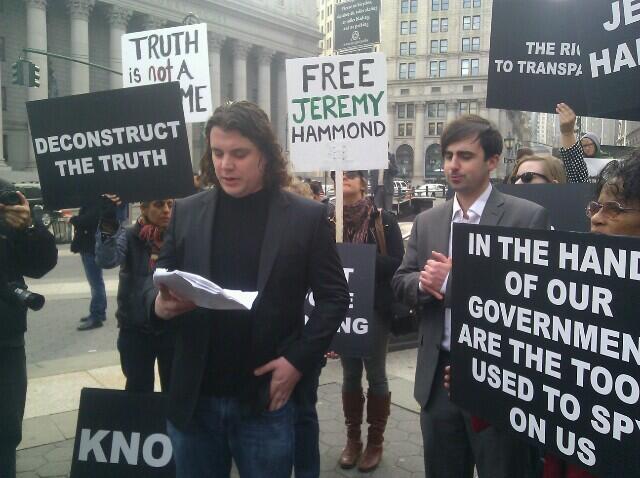
The day of Jeremy’s sentencing hearing, I gave a speech at Foley Square outside the courtroom and some interviews about the value of the Stratfor leak. The leak will continue to benefit researchers for years and years. Journalist Chris Hedges (Wikipedia), journalist Alexa O’Brien (Website, Twitter), and defense attorney Jay Leiderman (Website, Twitter) also spoke at Foley Square.
If you want the short version, check out this interview of me conducted by Jeff Durkin (Twitter) of We Are Change Connecticut (Website, YouTube). It was right after the speech. The interview is about seven minutes long and came out really well.
If you want the long version, here is a video of all four speeches and more by Small Affair (Twitter, Tumblr, Donate, Occupy the Stage). My part is from 36:00 minutes to 49:30. Small Affair also took the picture at the top of this post. Below the video is the prepared text of my speech.
[wposflv src=https://douglaslucas.com/FreeJeremySpeeches.flv previewimage=https://douglaslucas.com/blog/wp-content/uploads/2013/11/DALStratforSpeech.jpg width=400 height=325 title=”Free Jeremy Speeches”]
This morning we saw young but longtime hacker and political activist Jeremy Hammond unjustly sentenced to ten years in prison for, among other actions, hacking confidential emails out of the Austin-based private intelligence firm Stratfor, the leak of which WikiLeaks is now publishing. The five million-plus emails Jeremy provided to us through WikiLeaks span 2004 to 2011 and consist of internal and external correspondence, files, and records of the firm’s analysts, spies, executives, writers, and other employees.
I want to talk for a few minutes about why what Jeremy did has been and will continue be so beneficial to us—that is, I want to talk about the value of the Stratfor leak, which is Jeremy’s contribution to what we can call the historical record or humankind’s knowledge repository or simply just the Internet. For more than a year, I’ve been intensively researching the complete cache of Stratfor documents in WikiLeaks’ possession. I’ve published two in-depth articles at WhoWhatWhy using my research, have a third coming out soon there, and many more in the works.
When WikiLeaks began publishing the Stratfor leak, which it calls the Global Intelligence Files, much of the reaction from the US mainstream media was dismissive. The Atlantic published an article the same day WikiLeaks announced the leak, titled “Stratfor Is a Joke and So Is WikiLeaks for Taking It Seriously.” The Atlantic writer, of course, did not read the five million-plus emails. Rather, he was probably acquainted with Stratfor’s free email newsletter reports and media appearances and was itching to discredit WikiLeaks and its source, who we now know was Jeremy. But what the Atlantic writer was acquainted with was just the surface of Stratfor.
The firm does so much more. In the 2004 to 2011 time span the leak covers, Stratfor provided training and created custom intelligence products—reports, predictions, assessments—for big corporations such as Hunt Oil, National Oilwell Varco, Parker Drilling, Lockheed Martin, Dow Chemical, and for government arms such as the Defense Intelligence Agency, the Department of Homeland Security, the US Marines, and many more. These people weren’t reading the free email newsletter reports. They were buying intelligence products such as Stratfor’s Yemen attack database, in which Stratfor catalogued incidents of violence in Yemen with precise information such as GPS coordinates. They were, in Emerson Electric’s case, paying more than a hundred and fifty thousand dollars a year for phone and email access to Stratfor employees who would brief them on political, economic, and security factors affecting their operations. So much of the information Stratfor was providing these clients is available to us now thanks to Jeremy, and most of it hasn’t been researched yet.
National security journalist Joshua Foust said this week that Stratfor isn’t that much different from a private investigator. P.I.s don’t have the clientele I just listed. They also don’t have Stratfor’s informants, who included Israeli Prime Minister Benjamin Netanyahu, Mexican diplomat Fernando de la Mora Salcedo, and DEA supervisor William F. Dionne, whom I interviewed and who provided Stratfor information off JWICS, a top-secret US government computer network. Much of what these informants were telling Stratfor is available in the leak, again thanks to Jeremy, and most of it, again, hasn’t been researched yet. So we still don’t yet know the full extent of Jeremy’s contribution.
Joshua Foust also said this week that the Stratfor emails “weren’t surprising” for people in the know. That’s false. And he said “weren’t surprising” as if the leak is already over. We’ve barely scratched the surface. The mainstream media in the US doesn’t want to research the information I’ve been describing, they’re not familiar with it, they don’t care. They bash Jeremy’s contribution on the one hand, but on the other hand, the New York Times (as documented by the NYT Examiner), NPR, and other news organizations collaborate or share information with Stratfor behind the scenes. That’s the US mainstream media for you, hypocritical. Turn them off.
There are easily decades’ worth of research remaining for the Stratfor documents. Not only are there more than five million emails, but many of them have PDF attachments of up to hundreds of pages each. Examples of these attachments include intelligence bulletins from the Drug Enforcement Administration’s El Paso Intelligence Center, Texas Department of Public Safety threat assessments and situation reports, and intelligence products created by Department of Homeland Security state fusion centers. There are even intelligence products created by Stratfor competitors whom the firm was studying such as Total Intelligence Solutions, the Institute of Terrorism Research and Response, and Oxford Analytica. So Jeremy didn’t just provide us with information from Stratfor, but also from other private intelligence firms and government intelligence organizations. Again, most of this material hasn’t been researched yet.
But here are some of the greatest hits of what has been uncovered so far.
The previously unknown Trapwire surveillance system was one of the biggest Stratfor revelations. This company with CIA ties developed software for CCTV cameras that identifies or supposedly identifies suspicious behavior and manages and cross-references suspicious behavior reports from different locations and time periods. It also integrates information from license plate readers and other surveillance inputs. Trapwire has been deployed in DC, Seattle, LA, Las Vegas casinos, Atlanta, the London Stock Exchange, and right here in the NYC subways, 500 cameras’ worth according to Stratfor in 2010. If someone “sees something, says something” about you in a New York subway, your “suspicious activity report” possibly goes to TrapWire. Thanks to Jeremy, we better understand mass surveillance, which is crucial, because giving the people who brought us mass incarceration, more than two million people behind bars in the US, the technology to incriminate anyone, whether rival politicians or ordinary citizens, is obviously an immense threat to freedom.
My work at WhoWhatWhy on the Stratfor documents, thanks to Jeremy, includes an article about General David Petraeus, whom Stratfor shows was probably having an extramarital affair prior to previously known, which besides possibly being a military offense, suggests his mistress Paula Broadwell, who was an intelligence officer, may have had him in her crosshairs for a long time. That makes more sense of Petraeus’s downfall from the CIA and gives a better picture of internal government struggles. Another article of mine is on the Drug Enforcement Administration’s Special Operations Division seeking White House permission to assassinate Mexican drug lords. That’s a picture of the increasing militarization of law enforcement and the possible broadening of US assassination policy to merge the war on drugs with the war on terror–a push for a so-called “narcoterrorism” policy. Later this month WhoWhatWhy will publish another Stratfor article of mine of Mexican military presence in the US and US military presence in Mexico. Thanks, Jeremy.
Another contribution of his are the revelations in the media outlet Narco News about the US and Mexican governments easing the path for certain cartels to traffic drugs into the country. Instead of improving the Mexican economy so poor people don’t join cartels or legalizing drugs, the US and Mexican governments pick favorites among drug cartels in hopes that a preferred balance of power among them will reduce the drug war violence. Meanwhile they arrest people for smoking pot. This is a picture of what the drug war really is. And I’ve seen in my research that even Congresspeople are listening to Stratfor on so-called narcoterrorism issues.
Thanks to Jeremy, we learned private intelligence was looking for connections between Alexa O’Brien’s campaign finance reform group US Day of Rage and Islamic fundamentalism, which of course carries the threat of Alexa being smeared as a terrorist. That particular Stratfor memo was cited in her and Chris Hedges’ court case against indefinite detention that went to the Supreme Court. We also learned thanks to Jeremy that the Department of Justice has a sealed indictment against Julian Assange of WikiLeaks, indicating the severity of the US government’s efforts against journalists and the Internet. This revelation was cited by Assange in an affidavit to Swedish police.
There are plenty of other revelations in the Stratfor documents. Those are just some of the greatest hits. You can get involved researching the Stratfor documents yourself. Look them up on the WikiLeaks website, where there is a search engine to look through them.
You might say, Okay, so we grabbed a few headlines, and maybe a few legal documents benefitted, but what’s the use, what does it all add up to? We know Jeremy’s legal case was unjust. The FBI knew Stratfor was being hacked for weeks and did not stop it, and entrapped Jeremy through their informant Sabu. Judge Preska denied Jeremy bail wrongfully. And the sentencing is irrational: if Jeremy had broken into the Stratfor building in Austin and walked off with hard drives, he might have a prison sentence of only about a year. There were other actions he did, but since the US government is cracking down on the Internet and journalists and their sources, he’s stuck with a much more severe sentence. So now he’s in prison. Are the news headlines, past and future, worth that? He says so, but are they really?
Yes. For one, these revelations are examples of why more and more people are ceasing to take the US government and traditional politics seriously. The fewer people trust in the Democratic Party, the better. People who grow disgusted with the System as a result of revelations such as these will begin to look to themselves and solidarity for solutions. Solutions such as the commons or mutual aid. Instead of trying to reform or overthrow the government, we can simply practice governance. Internet technology is a tool that makes mass collaboration for mass self-govenance possible, which is something Heather Marsh writes about, if you know her work. If not, read it.
The best way to look at what Jeremy did is to see it as a permanent contribution to humankind’s knowledge base, our knowledge base, the Internet. Think about checking your phone to look something up. We all know what it’s like to look something up online and find an answer, and we all know what it’s like to feel grateful when we find an especially good answer. That’s the sort of gratitude we should feel toward Jeremy. He improved our knowledge; he’s given us better answers, and they are answers about some of the most important things: what the powers who try to control us are doing. With better information, we can make better decisions and govern our own lives.
Fundamentally, Stratfor is a profit-driven business. It influences big business, government, and the media. It’s an organ of the powerful, but despite its power over all our lives, Stratfor’s employees are not vetted by the people and it’s not open to Freedom of Information Act requests. The knowledge it held between 2004 and 2011 was locked up behind closed doors.
But Jeremy freed it. For that, journalists owe him hard work researching the Stratfor documents, and we all owe him our thanks.
That evening, Vivien Weisman (Twitter) interviewed me about Barrett Brown and my Stratfor research to include in her upcoming documentary The Reality Wars, which is about hacktivists.
Also that evening, I was interviewed on Lorax Live (Website, AnonOps Radio, Twitter, Facebook) about the value of the Stratfor leak. The audio is not online yet, but I will update this page when it is.
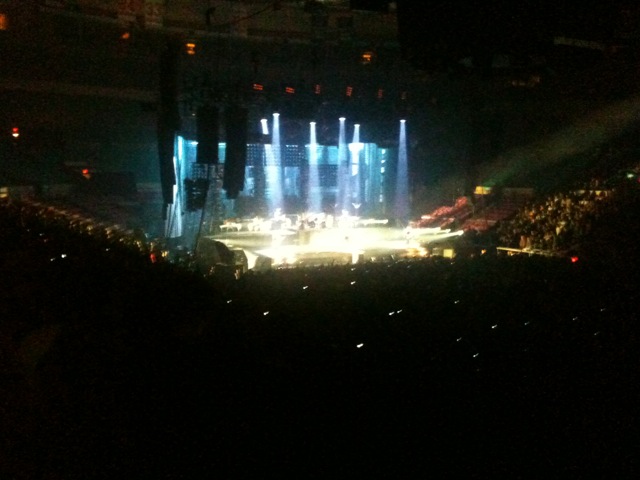
Saturday night, December 11, I went to a Rammstein concert at Madison Square Garden, my ticket purchased by the best wife ever, Wifely. At the Garden, for about 2.5 hours, the band wonderfully bulldozed my ears. The full set list’s at the end of this post.
To get to the concert, I took the D-line from my friends Janna and Julie’s apartment in the Bronx, then walked a few blocks through Manhattan. A hand-holding, formally-dressed teenage couple arrived at about the same time I did, also threading their way through the assortment of headbangers in fishnet stockings and/or leather jackets & the like. The couple showed an elderly usher their tickets. “No,” he told them, “you don’t want a Rammstein concert.” He gestured. “You want that over there, the stage play.”
I went in.
Nice view! Freebie iPhone pic by me.
Luckily, I (purposefully) missed the opening act, some obnoxious group called Combichrist. I sat (with a great view! How awesome is Wifely???) next to a guy named Kirk, with whom I talked for a while; his girlfriend goes to NYU, he studies education in Pennsylvania.
I wondered if the techs soundchecking the guitars were going to play the main Sweet Leaf riff (the Black Sabbath song title refers to especially tasty tea), or if the tradition of using that riff for metal soundchecks was just an American thing. Well, Rammstein’s soundcheck was really short, which was sort of surprising — just a kick drum check and a power chord check. I have to say the kick drum sounded incredible reverberating around Madison Square Garden.
The lights blacked out suddenly, and after a Spinal Tap-worthy smashing of an artificial wall, the band came onstage for the night’s first song, “Rammlied” (“Ram-song”). The lyrics start with (and frequently repeat) the word “Rammstein” (Ram-stone), which the crowd loudly screamed, fists pumping and heads a-bang, as a very emphatic spondee. I was definitely among the fist-pumpers, for once at a concert where I wasn’t so self-conscious. When the German verses begun, the largely American audience’s fists lowered, their heads rose, and their faces searched one another, puzzled as to how to proceed. Then the chorus came back (Ramm-! -stein!) and the crowd resumed its chant. Any German the crowd managed seemed mostly mumbled until a familiar-enough word crossed by. This was amusing. For all we knew, Till Lindemann, singing mostly in German, could have been cursing us out the whole time!
Here’s what the music sounded like — seriously! Did I not tell you Rammstein plays Bavarian folk music?
During “Ich tu dir Weh” I saw, through the scrim of pot smoke pouched above the bottom floor, a man dressed head-to-toe as Santa Claus, moshing in the pit as intensely as anyone else. Like the band themselves, most Rammstein fans above their teenage years do have a sense of humor about this music and its subculture.
The concert ended with Till enunciating very slowly and very carefully, something like: “We are Rammstein. We thank you very, very much, America.” The closing song was “Engel” (“Angel”), and we walked out to a piano rendition of it, which was quite spooky and nicely fit my sudden sadness at the concert ending. I was so happy, though. On the way back to the Bronx on the D, my ears were, like, deaf, so on my headphones I listened to Patty Griffin, not coincidentally among Wifely’s favorite music.
By the way, before the concert, some guy standing by the elevators handed out what looked like playbills to passersby, some of whom happened to accept them. On the back, I noticed, MSG Entertainment, apparently Rammstein’s management — whom as a ticket-holder I have no relationshp with — asserts the following (though in all caps, and among other things) as part of a “license” (their word) that they granted:
No smoking, alcohol, drugs, weapons, laser pens, food, bottles or cans allowed. By your use of this ticket, you consent to a reasonable search for prohibit items and you agree that you will not transmit or aid in transmitting any description, account, picture or reproduction of the event to which this ticket admits you.
Apparently in Germany they don’t have the saying “Any publicity is good publicity.” And besides, just because some moistened bink lobbed a playbill at me doesn’t make me a licensee.
For a disturbing, if overblown, take on Rammstein, try this essay by Claire Berlinski: Rammstein’s Rage. (FYI, at times the essay mis-translates in a way that misleadingly bolsters its points; but, it’s still worth a read.)
I'm a Texas-born, Seattle-based freelance writer/journalist currently living in Chiapas, México. Published at Rolling Stone, Foreign Policy, Salon, WhoWhatWhy, the Texas Observer, the Daily Dot, others. I write about anything and everything, but usually current events meets investigative journalism and philosophy; liberatory mental health; education; science fiction and fantasy; technology; justice; more. Also a former public ed substitute teacher.
Email: DAL@RISEUP.NET (ask for pgp key or check keyservers if you want encryption)
Snailmail (United States Postal Service only): Douglas Lucas / PO Box 75656 / Seattle WA 98175 / United States
Snailmail (Private carriers such as UPS, Fedex, DHL, Amazon): Douglas Lucas / 11036 8th Ave NE #75656 / Seattle WA 98125 / United States
Note the single-character change in ZIP codes, between the address for USPS (98175) and the address for private carriers (98125), is not a typo.




 Twitter:
Join the conversation