The Celestial Jukebox by CynthiaShearer. Multicultural small town tries to get along; when I first donated to Occupy Dallas, the site made me think of the grocery store in this book.
descant Summer 2007 (Volume 46) issue, which includes “The First Death of 2057” by me. A short story about punishment, capital and otherwise, in the future.
The City & The City by China Miéville. Detective story set in two cities in the same place; it’s taboo for one to observe the other; quite fitting.
Night Shift by Stephen King. The earliest short story collection from this horror-meister. I figured if you’re reading in a tough place these stories, for some, might actually be comforting, simpatico.
Fahrenheit 451 by Ray Bradbury. Dystopian novel about a world where people don’t read. On Nov. 15 police destroyed about 3,000 books from NYC’s Occupy Wall Street Library (video; article).
Bag: water sealant for the bookcase and various new batteries.
The books went into the tent above; the guy who received the donations told me they’d probably use the bookcase elsewhere. I wonder who read the books and what they thought and if it made a difference.
Occupy Sesame Street comment, in the voice of Cookie Monster:
Yes, there always going to be rich and poor. But we used to live in country where rich owned factory and make 30 times what factory worker make. Now we live in country where rich make money by lying about value of derivative bonds and make 3000 times what factory worker would make if factories hadn’t all moved to China.
Capitalism great system. We won Cold War because people behind Iron Curtain look over wall, and see how much more plentiful and delicious cookies are in West, and how we have choice of different bakeries, not just state-owned one. It great system. It got us out of Depression, won WWII, built middle class, built country’s infrastructure from highways to Hoover Dam to Oreo factory to electrifying rural South. It system that reward hard work and fair play, and everyone do fair share and everyone benefit. Rich get richer, poor get richer, everyone happy. It great system.
Then after Reagan, Republicans decide to make number one priority destroying that system. Now we have system where richest Americans ones who find ways to game system — your friends on Wall Street — and poorest Americans ones who thought working hard would get them American dream, when in fact it get them pink slip when job outsourced to 10-year-old in Mumbai slum. And corporations have more influence over government than people (or monsters).
It not about rich people having more money. It about how they got money. It about how they take opportunity away from rest of us, for sake of having more money. It how they willing to take risks that destroy economy — knowing full well what could and would happen — putting millions out of work, while creating nothing of value, and all the while crowing that they John Galt, creating wealth for everyone.
That what the soul-searching about. When Liberals run country for 30 years following New Deal, American economy double in size, and wages double along with it. That fair. When Conservatives run country for 30 years following Reagan, American economy double again, and wages stay flat. What happen to our share of money? All of it go to richest 1%. That not “there always going to be rich people”. That unfair system. That why we upset. That what Occupy Sesame Street about.
2011 article from Rolling Stone: Why Isn’t Wall Street in Jail? Bankers commit economy-destroying crimes — actual crimes — and remain on the loose; meanwhile, many anti-Occupy folks (especially cozy liberals) are interested in nitpicking park regulations … WTF?
Occupy Dallas footage uploaded to YouTube (by someone else) on Nov 19, 2011:
On October 11 2011, with the help of a friend’s warehouse club card, I purchased 392 20-oz bottles of water (and elsewhere, some gas) using donated money entirely, for the purpose of bringing bottled water to the Occupy Dallas (Twitter) group. I was going to make a table of the ten donation amounts, complete with mean, median, and mode, but my other friend who’s a whiz at statistics told me that with such a sample size, I’d be making a complete fool of myself to post anything other than gross and net. Here you go: $100, $100.
Even the Honda Fit groaned under this water’s weight
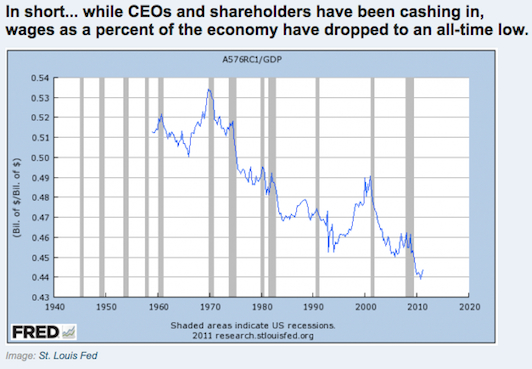
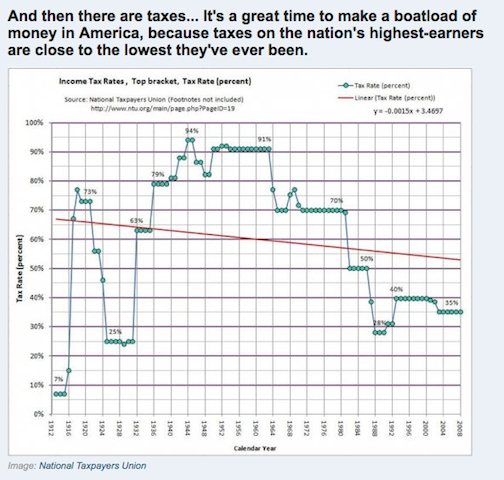
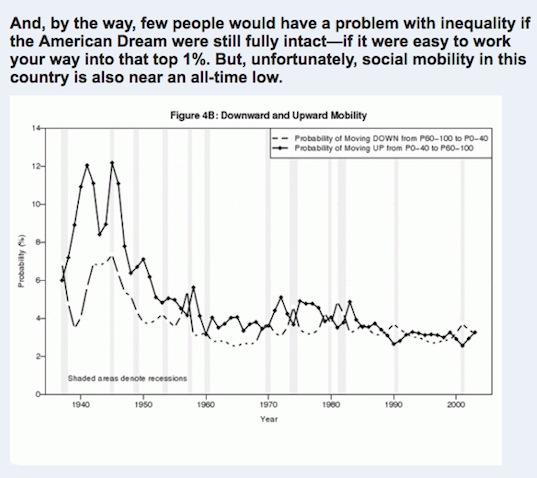
Occupy Dallas is part of the larger Occupy Wall Street (Twitter) movement protesting genuine grievances, primarily income inequality and the unethical merger of governments, mega corporations, and big banks. I’ll throw the surveillance shadow state in there as well. If you’re so cozy within your white picket fence that you don’t see a problem, gander at these graphs from Business Insider.
The 99% aren’t asking for equality of opportunity or results.
Still voting Republican? No? Okay, good. Because the right-wing works by convincing enough people who have the resources to take off work and go vote that they, these voters, are the 1%. You too will own yachts! Actually, no, you won’t. Most you might be able to pull off is maintaining your white picket fence (if you have one), or rather, maintaining the bank’s white picket fence — banks own more home equity in the US than individuals do. Meanwhile the Democratic left, that is to say, more or less, everyone else taking traditional politics seriously, gets divided and disorganized arguing over how to best compromise with the 1% to achieve minor reforms — until populism such as Occupy Wall Street gains a loud enough nonviolent voice to bring about real change.
Hi y’all! You are also the 99%!
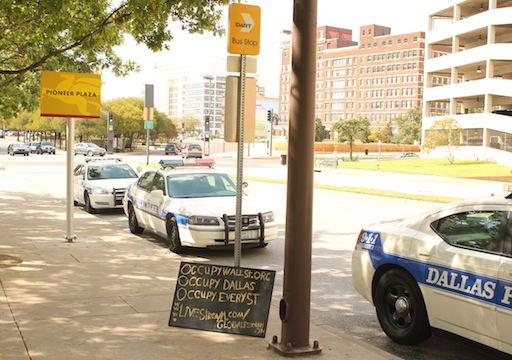
I stopped at Pioneer Plaza (the Dallas Occupation is now moving to City Hall Park) and, as a cop watched, hastily deposited my quarters into the parking meter. Activists at the Occupation then ferried water from my Fit to the supply base faster than I could pull my camera out. Peeps were thirsty. :-(
I had a minute to chat with the woman I understood to be Whytney (pictured left?), a leader there who is, I think I overheard, the chief operator of the OccupyDallas Twitter account. (Also: thanks to OccupyDallasCOS, OccupyDallasEMS, and CinnabarSweets for helping me out with some logistics.) I asked for, and quickly received, a list of other items — chairs, C-size batteries, walkie-talkies, shelving, ice, and more — that the 500-or-so people of Occupy Dallas desperately need. Working on that list now, y’all; I’m gathering donors.
Speaking of donations: hopefully, you’re now asking yourself how you can pitch in. There are plenty of ways.
Note: Edited by this selfsame writer in year 2020.
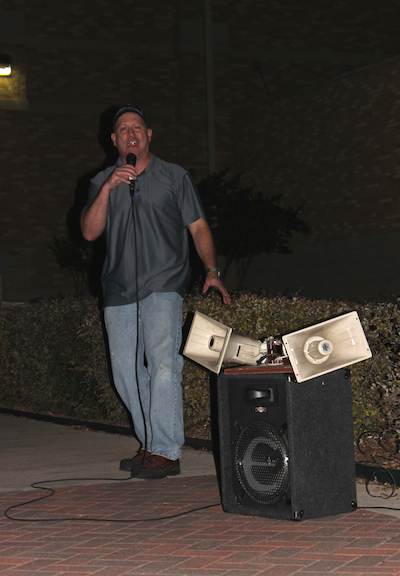
“YES, MY FRIEND-uh”
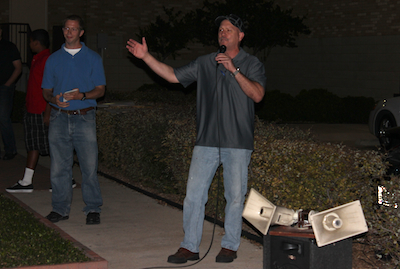
This Friday evening a group of maybe twenty folks have assembled at the corner of Berry and Cockrell to proselytize for Christianity; I happened to pass by and jump into live-blogging mode. The speakers from the group, some using English and one Spanish, have been speaking into a hand-held microphone and through a portable PA for easily an hour counting. They’re passing out pamphlets identifying themselves as The Door Christian Fellowship.
The pamphlet handed to me says, among other things, “Are your hopes and dreams unraveling? Are your finances stretched to the breaking point? We Care! and We Can Help! Join us for Life-Changing Services. Find out why Jesus Is The Answer!” It gave an address in Texas, along with a phone number.
“Douglas-uh, maybe you should move out of Texas-uh.”
They picked this particular street corner for obvious strategic reasons. It’s catty-cornered by the Texas Christian University strip, where clubs, restaurants, and the like entertain students. I don’t know if the group got a permit, or if they needed to, technically, or not. People walking or driving by have expressed various reactions — mostly happy honks and cheers, but a few jeers and some “SHUT THE F*#) UP”s.
“Can we go home yet?”
Here are some quotes from the speakers, 90+% accurate.
I know there’s [sic] been advances in technology. The answer is not on Facebook, my friends. The answer is not on Twitter, my friends. There is [sic] real answers in God. Before I got saved, I used to look into all those kinds of — Buddhism, and all kinds of new age stuff. But the real answer was right here: Jesus Christ.
On the outside, we’re dressed-up, my friend, we look like we’ve got it all together, but on the inside, my friend, you’re dying because of your sin. You wake up at night and wonder what will come tomorrow. On the inside, you cry yourself to sleep. You go from relationship to relationship because on the inside, you’re dirty. Jesus Christ will clean you. He wants to do that. The Bible says He will set you free. You can be set free from the lifestyle of drugs and alcohol. You can be set free from living for the next party, the next big thing. Jesus Christ can change who you are on the inside, my friend. Jesus can change you. He can change you, my friend, so you don’t have to end up like your parents.
Your parents are paying for you to go to college, probably, and you’re wasting that money tonight by getting drunk so you can sleep with someone, maybe. But you will be free for real if you cry out to Jesus Christ!
Maybe you’re a queer — it takes God to save you.
God commanded us to go forth and preach the Gospel. We go all over the city and preach Jesus Christ. We’re not here tonight because we’re trying to put something on you. I love Fuzzy’s Tacos, my friend; amen, it’s nothing against anybody, my friend. We really care about you. We don’t want to see God put you in Hell.
Accept Jesus before it’s too late. If you reject the perfect and living God, he will reject you for all eternity and send you to Hell.
It’s this same group (different day, different place in the same city):
They’ve just now put away their gear and dispersed. As they were packing up — I was typing this from the patio of Stay Wired! Coffeehouse and Computer Services — a guy and girl walked by, dressed up as Jedis, complete with lightsabers. Works for me.
Used without permission; please don’t go after me, buy Star Wars instead.
After Monday’s suicide of Russell Armstrong (a Real Housewives of Beverly Hills star’s estranged husband), Matt Zoller Seitz of Salon.com called reality TV “A blood sport that must change.” Seitz said:
The type of so-called reality show represented by the “Real Housewives” franchise is the soft-bellied, 21st century American TV version of a gladiatorial contest. It has no agenda except giving viewers the basest sort of entertainment: the spectacle of people doing violence to each other and suffering violence themselves. Instead of going at each other like gladiators with swords and clubs, or like boxers hurling punches, participants in this kind of unscripted show attack each other psychologically. The show’s appeal is the spectacle of emotional violence. The participants — or “cast members,” as they are revealingly labeled — suffer and bleed emotionally while we watch and guffaw. […]
Unscripted shows encourage, and sometimes cause, emotional damage. That’s the whole point of their existence — the reason they get on the air, the reason we watch and discuss them. They record intense, bizarre, sometimes ginned-up conflicts during production. They transform the participants into caricatures of themselves […]
Yesterday I asked a story editor on a long-running dating series who did not want her name used in this story if, during her years of working on these shows, she had ever heard a producer express authentic concern for a participant’s well-being as a person rather than an abstracted “character.” She laughed and said, “No. That just doesn’t happen. If anybody working on this kind of show thought that way, it would make the shows less entertaining, and that person would lose their job.”
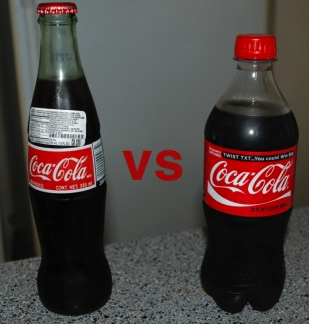
Tonight I went to the corner grocery store to buy Wifely some Skinny Cow dessert and me some Mexican Coke. The cashier, a young woman, wore a nametag that, under her name, said:
I LOVE U :)
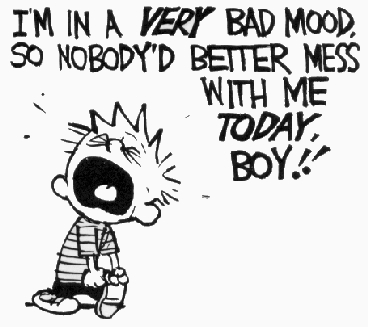
I thought to myself: that’s an exuberant nametag. Although people who aren’t actually in my skull insist otherwise, I do automatically, non-voluntarily think such words as “exuberant.” If that annoys you, you probably shouldn’t be reading my blog, but rather watching Real Housewives of Beverly Hills.
No one was in the lane behind me, nor was anyone nearing the lane. For a moment I considered saying something or other to the cashier about her nametag. After all, I’ve checked out through her lane enough times for us to share mutual recognition, though just barely. I prefer to interact with a person when checking out, instead of using the self check-out lanes, because something worthwhile, interesting and unique and unpredictable, might happen during my encounter with another human being.
Then for another moment I considered not saying something about her nametag. Because by now the time for exchanging a greeting had nearly ended, she was starting to scan my Mexican Coke, she was about to ask if I’d brought my rewards card (I always lie and say I forgot; cashiers then scan theirs on my behalf, and not only do I not have to deal with signing up for one, but also I singlehandedly defeat the company’s entire research division). But the only word coming to mind during this expiring hourglass time was exuberant.
I decided not to chicken out, to go for it.
“That’s an exuberant nametag,” I said.
Her smile wriggled as happily and confusedly as she did until she stopped to ask what “exuberant” meant. Ah-ha, I thought, a person who doesn’t become angry like so many do when someone else uses a word they don’t know, but instead has the laudable reaction of curiosity. Now it was my turn to wriggle my hand happily and confusedly, trying to pantomime the meaning of exude while telling her, “It means, like, … happiness … like …” I managed to stop stumbling and say “It means something like, ‘Shining out happiness.'”
She said, “I really like that,” and I sensed she meant it. A few moments of silent, shared satisfaction passed as she scanned my items.
Photo ofPhilip K. Dick by Anne Dick “I ask, in my writing, What is real? Because unceasingly we are bombarded with pseudo-realities” — PKD
One of the commonplace remarks about reality TV is that it “isn’t real,” that it’s merely “so-called” reality TV. This supposed phoniness is alleged to cover up the “natural” way of being, the “real” way, which is usually not identified by the shows’ deriders.
As I paid for the grocery items, I nervously — as if invisible judges were watching — began to, as they say, “walk it back”: retract and qualify what I said. Anxiously I told the increasingly disappointed cashier the following nonfiction anecdote from a few days back:
I walked down an aisle at this same corner grocery store to pick up some ice cream. A middle-aged female customer was squatting down with a freezer door opened, scrutinizing the vanilla flavors. Without my saying anything, she suddenly started talking haphazardly about the proliferation of vanillas. French vanilla, old-fashioned vanilla, vanilla bean and more. “She told me to get vanilla; I wonder which she meant? There are too many!” In a bad mood, I didn’t want to talk at first; like a person wearing sunglasses indoors, I didn’t want to interact with anyone, didn’t want to engage with people. I resented her a little for introducing conversation. Then I regretted my self-absorption and told her I suspected old-fashioned vanilla would do the trick. The woman half-nodded sorta-assent, and said, as I walked away, “‘Tis a quandary.”
Walking away still, I looked back at her, and she was still squatting, not looking at me. I felt irritated that she hadn’t continued the conversation, that she’d used the word ‘quandary.’ How would she have known I knew what it meant, anyway? Now I was feeling like those who call big vocabulary pretentious. But I guess something small helped her recognize that I’m the sort of odd person who knows odd words. I still feel bad for not engaging with her, for choosing instead to cultivate my sour mood.
I explained all this to the I LOVE U :) cashier who, like I said above, appeared disappointed with me for walking-back the happy shared moment of exuberant. I was disappointed with me, too. But at least when I was driving home I thought up this blog post; I realized there was a big connection between these interactions and the reality TV issue.
At their peak the destructive emotions flaring during these reality TV shows are definitely real. (Perhaps those who decry the shows and miss this point don’t actually see much of them.) Real doesn’t imply good, doesn’t imply that the shows shouldn’t be changed. (I like Seitz’s suggestion of psychologists and better screenings; you can’t eliminate a phenomenon like reality TV; and, to pretend an underbelly doesn’t exist doesn’t help anything.)
Here’s the point. I think that in our postmodern world, people are so hungry for authentic moments of human experience that, even it means havoc or worse for the participants’ lives, they’ll take what these shows offer, if that’s all they know how to find. Because sincerely engaging with other people during the day, even through a good work of art, and sincerely emoting, is a scary risk.
As you might have heard, I’m working as a clinical schoolteacher — basically, doing three months of unpaid student-teaching en route to earning my full teaching certificate — as mentioned in an earlier post. The gig’s at an elementary school in the Fort Worth Independent School District, in an economically disadvantaged neighborhood. Many of these children, for instance, go home and spend hours and hours alone while their parent(s) work multiple jobs, and the children often lack proper clothing or supplies such as glasses.
But one student still thought to get me, in addition to my coordinating teacher, a Valentine’s present:
For me! (Pic = Public Domain; attribution & linkage = nice)
My observations so far largely fit with what I’ve observed as a substitute teacher, a role in which I often substituted for an aide, and for the same teacher across several days. So, as a substitute I did watch regular teachers teach.
They’re mean to students. Often.
According to the fantastic instruction FWISD’s Substitute Academy gave me on behavior management (I call it “crowd control”) — and this jives with my personal experience — administering sarcasm destroys your credibility and your relationships with students more than anything else. Sarcasm’s really nothing more than a way for teachers to vent their frustration and scare students — a losing strategy, in the long run, since students lose much of their respect for downright mean teachers and don’t learn as well. There’s no need to be a Tiger Mother.
For example, teachers will yell at students for not following worksheet directions, when it’s clear the students often don’t understand the directions because, say, they can’t read them without glasses, or they’re interpreting the unfamiliar words in a novel way, or the terrible textbooks’ directions are ambiguous in the first place. And this anger when they come to the teachers asking for help with the directions!
Of course, in disciplining children, there’s no reason to coddle and give ribbons for every good deed, either. But there’s nothing wrong with treating children with kindness, telling them thank you, praising them for succeeding at what is actually difficult for them — following directions, focusing, getting an answer correct, and so on. Telling a student “Good” never killed anyone, and an encouraging, welcoming classroom community helps students learn; yet, so often I hear teachers mock students and then support their offensive behavior with a chest-pounding, macho, “toughness” credo. Yeah right. Maybe you’re just a jerk, or maybe you just don’t know what you’re doing.
Way over on the other hand, though, it sure is easy for me to spend a week or two in a new community — the school — and pass judgment, especially when I’m not under the strain regular teachers are. (Teaching to the high-stakes tests, for instance.) Kind of like committing a cross-cultural drive-by. And, I don’t want these schoolteaching blog posts to turn into passive-aggressive attacks on my co-workers, you know? But I’m calling it as I see it, and when the time seems appropriate, I’ll mention my concerns to my superiors. I do defer to their chain of command, perhaps too frequently; but, when you’re the low man on the totem pole, brazenly passing judgment isn’t always the best thing to do — especially when my superiors have years of experience that might inform their actions in ways I don’t understand yet.
Of course I don’t really believe any of that… Though I do believe this: in assessing the public school system, you can’t point fingers at any one problem (especially just because it might be politically popular to rag on that problem). The errors are system-wide; everything from underfed, hungry students to funding problems to malevolent teachers to absent parents to … You can’t single out any one thing, and you can’t ignore the good work that’s being done, either.
But I’m furious at the way teachers write off students’ misbehavior (or just problematic behavior) as due to some sort of intrinsic “badness” of the children that the teachers act like they’re incapable of addressing. I’m not really furious at the teachers, but at a culture-wide reluctance to adopt a philosophy such as Pragmatism, where one doesn’t opine about metaphysical ethical essences, but just takes the most practical assumption. Assuming at-risk students are intrinsically bad might be practical if you don’t want to stick your neck out, or if you don’t want to make the extra effort, but it’s not practical if you want to help people. And children are people. After all, adults are often just as immature as they are.
And what about gathering the courage to ditch the paint-by-numbers worksheets and make your own material, material that’d be relevant to the students and help them understand and care about their work? In class we read this long story about settlers’ candle-making. These children have no idea what the “mold” is that settlers used to create candles. There were too many paragraphs for the story also. Why not write two or three paragraphs about the snow days, answering some questions you overheard the students ask about the weather? When it’s not busywork, and when the material is relevant to the students’ lives, discipline problems often disappear.
As to that student who needs glasses (see earlier post). Some questioning, and my own experience, indicates the delay in getting glasses to students is a persistent and district-wide problem. If my questioning about the glasses supply chain turned up correct answers, a corporation called Essilor is the contractor responsible for getting glasses to students, as the students are entitled to receive under various federal legislation (if I recall correctly). The contractor apparently operates under a (state? federal?) grant, which means they have an obligation to do their work (i.e. it’s not charity), and that grant might specify a timeline for delivering the glasses. Also, the grant should be publicly available; via Twitter or email, I’ll ask organizations such as ProPublica how to track down the grants, and if I have to, I’ll file an entire FOIA.
My first day as a clinical teacher went very well. Except: I’m exhausted!
Right now the coordinating teacher and I are together in the same classroom throughout the day. She’s running the reins, and I’m just observing, sitting at the side. Eventually I’ll be able to lead some activities. I’ve done that before when I’ve substituted for the same groups of students across a continuous week or so, but this would be more serious, especially as it’s long-term.
The day began quite early; my alarms blasted off at about 4:30am. I showered & got ready, and Wifely Kate cooked breakfast:
iPhone pic by me, public domain for you. Food by Kate!
How awesome is that? The coffee was ready and everything. I was able to write fiction for about an hour and fifteen minutes — quickly revising (line-editing) an older, completed story so I can re-submit it; didn’t quite finish, since I’m having to fact-check some details — and then I headed to campus, the lunch Kate packed me in tow. At noon-ish I discovered she’d left a note in my lunchbox. The note talked about how proud she is of me. I got teary-eyed!
The coordinating teacher uses a Promothean ActivBoard (I’m not sure if the link points to the exact same model) in some very effective ways. For one portion of the classes, she shows multiple-choice math questions on the ‘Board, then the students record their answers using controllers — all students have one on their desks. The coordinating teacher shows the results on the ‘Board — as a bar graph; looks like something off Who Wants to Be a Millionaire? — and uses them not just to motivate the class (the students love the video game-y vibe), but also to hone in on the students’ misunderstandings of the material in order to explain it again. Good real-time assessment.
Weirdly, one of the few TV shows I really like
The ‘Board can even export the collected data, so at a later time, we can analyze the answer statistics more precisely to spot recurring troubles. Totally something out of a Tim O’Reilly project.
Since I was mostly only observing — catching up to speed on this campus’s schedule, rules, etc. — I focused on watching one student at a time. (I’ve blogged before about developing observationskills. As for characterization, can a writer quickly notice in real-life what makes another person absolutely unique?) I noticed a boy whom I think might need glasses. Squinting, tilting his head to see better, putting his face inches from his paper. There’s a school program to address vision issues, but I’m not sure how prompt it is. Watching how in need and at risk students are can be upsetting. I’ve seen it before, substituting.
This particular student is enthusiastic, often raising and waving his hand even before the teacher asks another question. His enthusiasm hasn’t been disruptive. He seems to be a bit in his own world — smiling to himself, thinking his own thoughts. Good kid.
After leaving the campus, I went to StayWired!Coffeehouse and Computer Service for two hours, where I’m helping out as a computer tech. After my two hours were up, I informally sat in on a meeting for Democrat CathyHirt‘s campaign for the Fort Worth mayor position. There, upon being asked, I talked a little about my experiences and observations working for the local public school system.
I have to confess I’m bewildered about the relationships between my roles as a writer, teacher, newbie activist, blogger, and tweep (Twitter person). For example, working as an activist differs from volunteering for a political campaign (as I did for Bill White), from working for one in an official capacity, from blogging reportage or opinion about it, from incorporating observations of a campaign into a fiction project, etc. It’s a bit unnerving when you’re sitting there with a few people talking local politics and you’re trying to figure out which hat you’re wearing, so to speak. I have no real idea how to resolve these mini-conflicts, and there’s no one right answer.
The convention for blogs to be frequently updated conflicts with my personal preference for long-form or at least mucho-revised writing; and, when I’ve tried to blog long-form writing in the past, it’s often come off as too complex (Latinate, twisted syntax…) and hasn’t been revised well enough — a bad compromise between careful long-form writing and a quick blog post. Really, if you’re blogging long-form pieces, you’re essentially writing e-books. Since I consider myself a non-commercial writer (i.e. my goal isn’t profit; that possibility is a fringe benefit; I don’t mean that I consider myself highbrow — I try not to think in those terms), I’m not against the idea of eventually releasing more of my creativewriting (fiction and otherwise) under CreativeCommons licenses, but I sense that right now, I still need the bigger bullhorns and reputation-build of established venues (i.e. magazines, publishing houses).
Vika covers Metallica’s Orion
The increasing online success of vkgoeswild (Vika Yermolyeva) has been a bit of an eye-opener for me. I thought she was cool before she joinedforces with Dresden Dolls drummer Brian Viglione (Hipstercultural capital snobby-stupid FTW! =p). Vika supports herself by receiving online tips and selling customized transcriptions online. Other artists and bloggers have figured out similar business models (search through Boing Boing for many examples and discussions). But for creative writing, I just don’t excel at the very short, very quickly written form, which seems to be necessary to any feasible online business model I can actually think up for right now.
Tomorrow I begin a 12-week placement as a clinical teacher within the Fort Worth ISD en route to earning a full-meal-deal schoolteaching certificate. Tonight I’m quite a bit nervous.
The campus is an elementary school. I’ve substituted a fair number of times in the middle and high school grades, as well as in economically disadvantaged neighborhoods. I love kids and I love teaching. It requires patience, empathy, honesty, effective communication, a strict but fair approach, courage, an understanding of how people (young folk are people, too) need structure, a knack for facilitating group activity, good documentation skills, the ability to coordinate with coworkers…
So I’m confident in my abilities and experience. The anxiety comes from other causes. I’m not at all the best when it comes to crossing t’s and dotting i’s when time is of the essence, and that’s a necessary part of most work. I still don’t have many of the nitty-gritty details figured out (where do I park?), but I’ve always been able to improvise as a substitute. “Bring it on!” is my basic attitude, but everyone, including me, gets scared.
Wifely Kate has been so supportive and generous with her help. This weekend we did a lot of prep stuff, such as buying me more button-down dress shirts, cutting my hair (I still have a big ol’ shock of cowlick-y hair, which seems to be undefeatable). Marrying her has been the best thing that ever happened to me. And not just because she’s cooking breakfast and packing my lunch in the early, early morning as I get my creative writing in before driving to campus.
Schoolteaching is also scary because of possible political and work-world implications of online activity, online personal opinions. Working — at least as a substitute — has made me an official public servant. And there’s a lot of controversy over schoolteaching — for example, the Texastextbookcontroversy. What if something I tweet — such as this in favor of journalist Glenn Greenwald — bothers a parent or a supervisor? Oh well! I don’t really know how to handle that other than how I handle personal interaction in general, which is to try to be honest, fair, and diplomatic. I’m not one to stay quiet and keep my head down.
I’m ready. Again: Bring it on.
I need to make public something else soon, too, but I’ll leave that as a cliffhanger due to time constraints: I gotta get some sleep!
My good friend CynthiaShearer said something in a long-ago (long-ago in net years) blog post, a review of Richard Yates’ novel Revolutionary Road, that has puzzled me for a while. Before I get all critical of a single phrase in her post, lemme say some positive stuff to block any negative feelings.
Her blog post’s awesome.
Cynthia’s awesome and her blog’s awesome.
Revolutionary Road and Richard Yates are awesome.
Thanks to Cynthia’s review, Wifely and I both read the novel, and we found it so worthwhile, the book has since become something of a touchstone in some of our conversations.
Now with the kindnesses out of the way, here’s my quarrel, or really, quibble jumping-off point. In the course of otherwise spot-on praise for Yates’ novel, Cynthia gives the following as a thought on the book:
The novel is flawlessly structured, three acts, and eminently filmable.
Confirming what I thought, my OS X dictionary gives the following definition for “eminently”:
used to emphasize the presence of a positive quality
Maybe Cynthia wasn’t using the word so specifically, but regardless of authorial intent…and setting aside commerce, writers upping their audience — i.e., considering aesthetics alone — why is it a positive (or a negative) quality for a book to be filmable? We don’t say: “That’s a great sculpture; after all, it’d make a fantastic piece of photography” or “That’s a great painting; after all, it’d make an excellent symphonic work.”
Connections between artistic content remixed into another art form can be worth pursuing and elaborating and evaluating, but I don’t see any basis for using as a criterion of aesthetic appraisal the ease with which an artistic piece can be remixed to another art form.
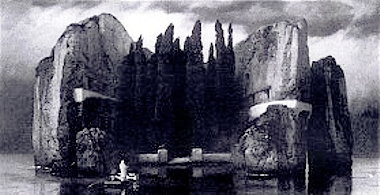
By the way, one of my favorite remixes of artistic subjects is Rachmaninoff’s symphonic poem Isle of the Dead Op. 29, composed in the early 20th century and then recorded with Rachmaninoff himself conducting. And yes, it’s “beginner’s classical,” shut up. Arnold Böcklin’s painting Isle of the Dead inspired Rachmaninoff’s piece — apparently the black-and-white version:
Here’s the color version:
And the music, low-fi and split into two parts due to copyright and YouTube limitations:
Anyway, the (wrongheaded!) idea of using as a criterion of qualitative judgment an artwork’s capability to be transformed from one art form to another got me to thinking: what can a novel do that no other art form can do? The closest (non-textual) art forms are probably plays (in performance) and movies (“movies,” not “films”; I don’t screen films, I watch movies). What can novels do that those art forms can’t do? I’ll not consider plays, as I haven’t thought much about them. So: movies.
In my tentative answers I’m going to put aside style, too, since sentence-level quality, I think, is a) not obligatory for a novel to be good, and b) not inherently novelistic. So, my first tentative answer: maybe novels can represent time, the workings of memory, changing perspectives, and the inner experience of emotions and thoughts better than any other form. As an example of what I mean (UPDATE: screenhead.com’s list of the hardest novels to film), Theodore Sturgeon’s excellent short story The Man Who Lost the Sea (legal full text at link) — warning, spoiler in the third quoted paragraph:
Say you’re a kid, and one dark night you’re running along the cold sand with this helicopter in your hand, saying very fast witchy-witchy-witchy. You pass the sick man and he wants you to shove off with that thing. Maybe he thinks you’re too old to play with toys. So you squat next to him in the sand and tell him it isn’t a toy, it’s a model. You tell him look here, here’s something most people don’t know about helicopters. You take a blade of the rotor in your fingers and show him how it can move in the hub, up and down a little, back and forth a little, and twist a little, to change pitch. You start to tell him how this flexibility does away with the gyroscopic effect, but he won’t listen. He doesn’t want to think about flying, about helicopters, or about you, and he most especially does not want explanations about anything by anybody. Not now. Now, he wants to think about the sea. So you go away. […]
His head isn’t working right. But he knows clearly that it isn’t working right, which is a strange thing that happens to people in shock sometimes. Say you were that kid, you could say how it was, because once you woke up lying in the gym office in high school and asked what had happened. They explained how you tried something on the parallel bars and fell on your head. You understood exactly, though you couldn’t remember falling. Then a minute later you asked again what had happened and they told you. You understood it. And a minute later . . . forty-one times they told you, and you understood. It was just that no matter how many times they pushed it into your head, it wouldn’t stick there; but all the while you knew that your head would start working again in time. And in time it did. . . . Of course, if you were that kid, always explaining things to people and to yourself, you wouldn’t want to bother the sick man with it now. […]
Say you were that kid: say, instead, at last, that you are the sick man, for they are the same; surely then you can understand why of all things, even while shattered, shocked, sick with radiation calculated (leaving) radiation computed (arriving) and radiation past all bearing (lying in the wreckage of Delta) you would want to think of the sea. For no farmer who fingers the soil with love and knowledge, no poet who sings of it, artist, contractor, engineer, even child bursting into tears at the inexpressible beauty of a field of daffodils—none of these is as intimate with Earth as those who live on, live with, breathe and drift in its seas. So of these things you must think; with these you must dwell until you are less sick and more ready to face the truth.
(Oddly for a science fiction story originally published in a straight-up “genre” magazine — The Magazine of Fantasy & Science Fiction — “The Man Who Lost the Sea” was selected for the 1960 edition of The Best American Short Stories.)
I’m not sure a play or a movie could represent the Sturgeon story, its workings of time, memory, changing perspectives, and inner experience as well and as concisely — or even at all. But that’s a huge disjunction: are plays and movies able to represent the Sturgeon story — just not concisely or well — or is there something inherent to the story that cannot be translated to another art form? I think that depends on how inherent an aspect of an artwork has to be for it to be considered inherent. ;-) And, how good does the movie have to be? The movie could voice-over or crawl tons of text to get closer to the original fiction format, but that (probably) would become annoying. You never know, however; artists are always figuring out new techniques. All the same, because representing time, memory, changing perspectives, and inner experience is at least a huge strength of fiction (and especially the novel), more and more I try to emphasize those qualities in my own writing.
I said first tentative answer, so how about this second one, which I can describe best in a metaphorical way? Novels are like multicharacter, revised, organized daydreams — or, imagine being a kid and playing with dolls or figurines, making up stories. That’s basically what novels are, I think, but not so much created daydreams worlds as the daydream-y experience of personal identity as a network of multiple narratives, comprised of images, emotions, etc., and stuck into the context of particular settings and social histories/influences and so forth. Sorta sounds like Bakhtin’s account of polyphony in Dostoevsky. But I haven’t read enough Bakhtin yet to say much; besides, his name sounds like Bactine.
Please don’t DMCA-takedown me, Bayer
This way of looking at what’s unique to novelistic form doesn’t seem to strongly entail the memory rumination or time aspects or changing perspectives I mentioned earlier, but yeah, I think fiction — especially when it avoids too much exposition and abstraction — stages a vehicle for experiencing a daydream related to identity and traveling in a specific historical or social context. Yet in “When Narrative Fails,” an article in May 2004’s Philosophy, Psychiatry, & Psychology, J. Melvin Woody makes an interesting case that other forms of art can do this, too:
“Why […] should we limit our understanding of the constitution of the self to the narrative? Indeed, why limit ourselves to language? Do not music and dance often articulate our passions more eloquently than any literary form?”
Nevertheless I think my second answer is pretty strong, and pertinent to why reading fiction is not just another hobby or preference, but something people who have the ability and resources and time to read it really should do so.
This month CBSDFW.com, the website for KTVT, the CBS station in Dallas – Fort Worth (that’d be channel 11), published some ‘Best of’ pieces I wrote for ’em. Here they are, with a tiny excerpt of each.
All Texans twenty-one-and-up need to have their own great margarita recipe, ideally, or at least know somebody — a bartender buddy, a sister-in-law, somebody close — who does. If a personal margarita can’t be made, however, there are plenty of places in Fort Worth on standby
At Ol’ South Pancake House, everyone — students pulling all-nighters, bikers, high-powered attorneys telling war stories, metalheads, cops — eats in the same few rooms together.
When it comes to alcohol, if you want to keep up with Franklin D. Roosevelt, Ernest Hemingway, and James Bond, you’ll have to learn how to enjoy one of their signature drinks: the martini cocktail.
With singers who desperately need surgery on their vocal cords, guitars that do their best to imitate sentient chainsaws, and lyrics straight out an illiterate criminal’s essay paper on “The Lord of the Rings,” heavy metal might not be music that you want to admit listening to.
Press the red button on your comfy chair’s tray and the staff will come take your order for wings, for a margarita, or for another margarita! After the show, be sure to sit out on the balcony — the view is fantastic — and debate the movie’s merits with your friends.
They were fun to write. I haven’t ever seemed to initiate discussion about any of my writing that’s been published, and I’m continuing that trend now. After publication, my primary role in a text’s life is basically done, save I guess for fixing typos or something in a theoretical reprint of whatever.
So: they were fun to write. Really! =D Hope you enjoy.
Yesterday, partly in a quest to be more sociable — and partly in a quest to save (improve?) the universe — I volunteered, phonebanking, for Democrat Bill White‘s campaign (Twitter; Twitter) for the Texas governor’s office.
Some bullet-points about Bill White:
The Houston area led the nation in job growth during Bill White’s years in office. It added more jobs than 37 states combined.
Houston voters returned him to office as Mayor with overwhelming re-election margins of 91% and 86%.
Bill White’s parents were schoolteachers, and he calls “education the most important business of state government.” He pledges to work toward increasing public education’s share of the state budget and toward making two- and four-year colleges more affordable.
He helped Houston free up an additional $80 million for parks and $40 million for libraries.
His main opponent, incumbent governor Rick Perry:
Perry opposes consensual oral or anal sex between anyone, gay or straight, as does the 2010 Republican Party of Texas; both want those acts to be illegal.
In 2009, with Texas unemployment at 8%, Perry expressed disbelief when others said Texas was in a recession. Earlier, that January, in the middle of Texas-record job losses, Perry turned down half a billion in federal stimulus funds targeted toward unemployment benefits for Texans.
Perry-appointed chairperson for the current Texas State Board of Education, Gail Lowe, removed Thomas Jefferson from the curriculum standards’ list of world philosophers, making space instead for 16th-century theologian John Calvin (among others); according to Max Weber and more, much Calvinism, if not Calvin, considered great success in money-making to be a sign that a person is one of the elect going to heaven.
Sarah Palin is endorsing Rick Perry’s gubernatorial run. The two appeared together at the Super Sunday with Sarah! event along with Ted Nugent, where Perry said: “Sarah Palin was a great person to put on the [Republican Presidential] ticket.”
I had a lot of fun phonebanking. Most of the time I was just leaving answering machine messages or marking numbers as disconnected (“or no longer in service”); when I did get a person on the phone, most all of them were very polite, even the Perry supporters. I got the hang of it quick, and definitely talked a few people into yard signs or text-message updates or whatnot. ;-) If you’re able to volunteer, I bet you’ll get the hang of it quick, too. Find out how to volunteer for Bill White!
I'm a Texas-born, Seattle-based freelance writer/journalist currently living in Chiapas, México. Published at Rolling Stone, Foreign Policy, Salon, WhoWhatWhy, the Texas Observer, the Daily Dot, others. I write about anything and everything, but usually current events meets investigative journalism and philosophy; liberatory mental health; education; science fiction and fantasy; technology; justice; more. Also a former public ed substitute teacher.
Email: DAL@RISEUP.NET (ask for pgp key or check keyservers if you want encryption)
Snailmail (United States Postal Service only): Douglas Lucas / PO Box 75656 / Seattle WA 98175 / United States
Snailmail (Private carriers such as UPS, Fedex, DHL, Amazon): Douglas Lucas / 11036 8th Ave NE #75656 / Seattle WA 98125 / United States
Note the single-character change in ZIP codes, between the address for USPS (98175) and the address for private carriers (98125), is not a typo.


















 Twitter:
Join the conversation