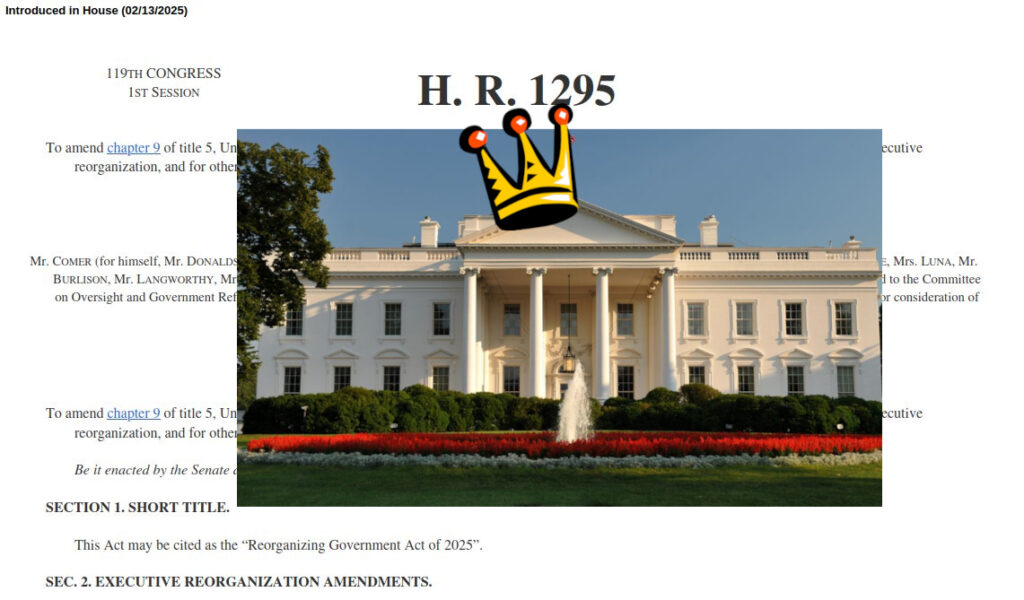
Mashed up by me from H.R. 1295 text via Congress.gov, Creative Commons photo of White House, and vector graphic of crown
Note: My Apr. 4 blog post—#TeslaTakedown Pt. 1 of 3: Crash course in Elon Musk, the DOGE coup, and resisting same—I published as part one of three. Under my own Douglasian reorganization authority, and to make my own life easier, I hereby declare this post part two of that series. Part three comes—eventually!
On June 4, Rolling Stone published my latest article: Republican bill would legalize DOGE and let Trump dismantle everything: The Reorganizing Government Act is a longshot in the Senate, but that could change—and so would the separation of powers. [Note added July 3: MSN and Yahoo republished it without paywalls.] As usual, I drafted more text than could be squeezed in, so please find below bonus material—mostly concerning statutory presidential reorganization authority’s history and some political philosophy—for the truly autodidactic among ye.
A short history of reorganization authority power struggles
The Reorganizing Government Act of 2025’s House sponsor, Rep. James Comer (R-KY), portrayed his bill during the Mar. 25 House Oversight Committee session as a fairly routine granting of long-gone special powers. “I want to reiterate that between 1932 and 1984,” Comer said, “presidents submitted more than 100 reorganization plans, presidents from Roosevelt to Reagan, used this authority to create or dismantle federal agencies.” While President Reagan did briefly hold Congressionally granted reorganization authority, he didn’t use it to create or dismantle any federal agencies—he didn’t even submit a single reorganization plan to Congress. To give Comer’s Southern drawl the benefit of the doubt, it sounds like he just misplaced the clause “presidents from Roosevelt to Reagan” in his sentence. It should have gone after “between 1932 and 1984″—then it would have been accurate.
Comer also claimed “Presidents Clinton, Bush, and Obama requested renewed and expand[ed] authority” to submit reorganization plans. None of those past presidents obtained the authority, especially because, not to embarrass Comer or anything, Clinton never even asked. At the meeting, no Representative corrected Comer, but the Congressional Research Service report he received unanimous consent to enter into the record, does. (It also explains the accurate Reagan history.)
Clinton in 1993 tasked Al Gore with cutting bureaucratic costs, and in each term, the then-vice president’s National Performance Review pursued that mission. Among the Review’s thousands of pages was indeed the recommendation that the White House seek reorg. authority. But the Clinton administration never took up the idea in earnest, much less formally requested such powers from Congress. Comer’s claim, apparently an attempt to turn such minutiae into a main character to normalize an unprecedented power grab for Trump, is specious.
Back in January, Trump told Congress that DOGE “is headed by Elon Musk”; Musk claimed the austerity team is akin to the concluded National Performance Review, which was a White House-led task force—as DOGE arguably is.
Yet Gore’s crew traveled the country to listen to agency staff and compile their ideas into wonkish suggestions for Congress and Clinton to consider—and faced no serious legal challenges. In contrast, Musk and his 34-timefelon president stand accused, in the AFGE lawsuit, of top-down rogue lawbreaking to dismantle government unilaterally from under the White House cloak of an efficiency task force. In their complaint, the plaintiffs write: “In sum, OMB [Office of Management and Budget], OPM [Office of Personnel Management], and DOGE have usurped agency authority, exceeded their own authority, acted in an arbitrary and capricious manner, and ignored procedural requirements by requiring federal agencies throughout the government” to “Impose cuts to functions and staffing according to ‘targets’ and ‘goals’ imposed by DOGE.”
Musk boasted of his team, “all of our actions are maximally transparent”—yet they tellrequesterssuing for records underthe Freedom of Information Act, No way, even after a federal judge found in March that DOGE is “likely covered by FOIA.”
If the so-called Department of Government Efficiency were actually a cabinet-level department created through Congress, it’d be very subject to FOIA and other obligations. But DOGE’s ‘name’ is a mere label Musk styled after a dog- (or doge-)themed cryptocurrency he’sdeniedowning in a contentous, closed court case. The operatives’ continuing refusal to disclose their names and their literal opacity—papering over windows in a basement conference room—has encouraged accusations, including from Senate Minority Leader Chuck Schumer (D-NY), that the crew of hacker-y twentysomethings is a “shadow government.”
At the Oversight session, Comer ignored or dismissed concerns about DOGE’s doings, painting his bill and the Trump administration as simply cleaning the government up of unnecessary bureaucrats: “We have to have a reorganization of the government—it’s gotten out of hand over the past 4 years! Bureaucracies have grown, bureaucrats have increased in number, and the people taking it on the chin in the federal workforce are the ones who actually do the work at the bottom of the organizational chart. This is a reorganization for them!” (Yeah, sure.)
Curiously, Comer didn’t discuss the first Trump administration’s reorganization authority request. The related Reforming Government Act of 2018 died prior to floor voting. Unlike Comer’s legislation, the Trump 1-erabills expressly forbade plans to ax independent regulatory agencies or all of their statutory programs and would have constrained the presidential powers by limiting them to “consolidation authority.” Like moving a computer file from one directory to another, deleting the former location’s in the process and hoping everything works out with the file in the fresh spot, consolidation authority would have presumably preserved whichever statutory programs’ existence when shifting their position in the org charts.
Consolidation authority similarly made the Trump 1 request less extreme than failed Republican reorg. authority legislation from earlier in the 21st century. President George W. Bush was, like top Trumpers now, pushing maximalist unitary executive theory: flex the presidency by bending or breaking the Constitution. Bush 43 would have obtained statutory reorganization authority—unexpiring—to propose ending departments, independent regulatory agencies, and some/all of either’s statutory programs, but only if his White House deemed the targets intelligence related. Obama’s request for two-year authority, by contrast, would have left independent regulators alone and stayed under consolidation authority for his plan to merge particular executive organizations: he said he’d arrange six of them into a new take on the Commerce Department, eliminating the old one in the process—so he technically needed the power to abolish departments. Republicans feared he wouldn’t stop with the Commerce Department, but that dispute seems minor compared to today’s Trumpian dismantlings: Neither Obama nor Bush 43 were boasting that they were gunning to end the Education Department altogether, as Trump is. And the expansive Reorganizing Government Act of 2025 envisions no consolidation authority constraint for Trump 2, making Comer’s comparison of his bill with Obama’s request bogus.
In hindsight, the Trump 1 effort comes off like a befogged dry run for the Heritage Foundation, much of the brainsbehind it—and behind today’s moreprepared, Project 2025-shaped Trump 2. After all, ideas for reorganization plans that emanated quietly from his relatively inexperienced, disarrayed first administration strangely amalgamized cross-partisan priorites: a smattering of low-profile, quasi-technical moves, among them merging food safety programs; centrist or liberal schemes like spinning off FAA air traffic control into a nonprofit corporation to better procure the latest, best staff and technology with less political interference; and conservative fixations such as prepping the U.S. Postal Service for privatization. That last is a jaw-dropping commonality between the 2018 and 2025 bids. In March, Musk agreed with Trump that the familiar, constitutionally authorized snailmailmen should be delivered to industry, saying, “we should privatize anything that can be[.]”
This most recent of reorg. authority’s three historical phases has seen Congress deny every presidential request for it since the statute last expired in (of all years) 1984.
Sometimes, these 21st-century bids have downplayed their expansive scopes by trading on the authority’s preceding, more widely popular mid-20th-century phase. That’s when Congress, often routinely, blessed most presidential reorg. plans, not infrequently advertised as merely improving the government’s operational mechanics. Reorganizers promised to steer clear of normative beliefs (somehow)—to remain agnostic about what Uncle Sam should do—and instead hyperfocus on tweaking how government operates.
These wonkish middle-phase plans—President Carter’s among them—have been lampooned as nothing more than “boxology”: shuffling agencies around on the org-charts without really fixing anything. Sometimes they have been rather mundane: President Kennedy’s first reorganization plan in 1963 restructured the Franklin D. Roosevelt presidential library with a change-up involving “ten guards, one repairman, and two janitors at a total cost of $87,000 a year.”
Other times, second-phase reorganization authority, largely freeing presidents from lawmakers’ snail-speed deliberations and entrenched dependencies on specific districts and states, facilitated surprising results quickly from a birds-eye view. For example, President Nixon’s third reorganization plan in 1970 created the Environmental Protection Agency, now targeted by DOGE.
Searches for historical evidence of major savings from this better-liked second period—or any period—of presidential reorganization authority will findlittle, aside from some of its uses in winding down World War II. The same report from 2012 that Comer entered into the record states that there have been “few instances in which reorganization plans resulted in documented cost savings.”
Reorganization authority’s earliest phase wasn’t so much about money, but about the first half of the 20th century generating widespread, amped-up hopes that significantly strengthening executive power to advance social goals could lead to sizable restructurings that would help heal the deep, long-lasting traumas of World War I, the Great Depression, and World War II.
The historical analogy isn’t lost entirely even on the unscholarly Donald Trump. He’s repeatedly invoked comparisons between himself and Roosevelt, who during the Great Depression and into the 1940s wielded enormous executive power mainly for very different ends: progressive New Deal social programs and fighting Axis countries instead of Trump’s You’re fired! commands for ever-smaller government and aligning with fascistleaders. Further, whereas Trump’s dismantlings this year have proceeded through a barrage of 150+ executive orders, many legally questionable—some paused by courts pending litigation—Roosevelt revamped government largely by ensuring Congress passed well-crafted, durable legislation.
Vanderbilt political science professor John A. Dearborn, who specializes in power shifts between Congress and presidents, told me that “FDR primarily viewed reorganization authority as a way to make government work more efficiently, and better, rather than simply as a tool to drastically cut back on agencies and functions.” That included a failed 1937 attempt to establish, at the same time as his proposed restructuring legislation would have granted him reorganization authority, a new Department of Public Works and a new Department of Social Welfare.
“Like Trump,” Dearborn said, “FDR was accused of seeking too much power for the presidency. He framed his ambitious reorganization proposal in 1937 as a way to ‘prove to the world that American Government is both democratic and effective’ while authoritarian systems were on the rise abroad. Congress scuttled many of the boldest elements of that plan”—among them not requiring him to seek Congressional review and its lack of an expiration date for his authority (almost always, when Congress extends the preorgative, it’s been on a temporary basis). “Nonetheless,” Dearborn continued, “while the reorganization authority lawmakers granted FDR in 1939 included some important limits on his powers, the law still relied on legislators’ assumption that a president would be uniquely focused on the good of the nation as a whole when formulating and submitting reorganization plans.”
The national culture backing FDR was an enormous facilitator of his reorg. plans and legacy. The culture back then was much more unified than today’s extreme polarization, as illustrated by the song “Why I Like Roosevelt,” originally from the 1940s. It’s embedded below as a 1990s-era recording of the elderly Willie Eason playing guitar in the Sacred Steel tradition and singing.
But another president Trump often mentions, this one trepidatiously, is much less well regarded, particularly due to his tariffs worsening the Great Depression. That’s Herbert Hoover, in 1932 the first president to receive from Congress statutory reorganization authority as presently understood, powers he’d championed as Commerce Secretary in 1924 for his then-boss, President Coolidge. During that year’s relatively mild recession, Commerce Secretary Hoover wrote that the public deserved “little right to complain about our economic situation”—foreshadowing Trump’s own Commerce Secretary, billionaire Howard Lutnick, lecturing this March that if Social Security checks go unsent, it’s “fraudsters” who’d complain, whereas in such dire straits, his elderly relatives would just hope for their next checks in patriotic silence.
Hoover ignored the warning a thousand-plus economists sent him and signed the Smoot-Hawley Tariff Act of 1930 to dramatically hike duties on imports. The Smoot-Hawley Act was a major part of that era’s tariff policy, which Trump said, in his Apr. 2 “Liberation Day” speech, would have stopped the Great Depression had tariffs—Hoover’s among them—been even more aggressive, as his own were: per Fitch Ratings, Trump’s early April effective tariff rate was reaching levels not seen since twenty years prior to 1929’s Black Thursday. His recent tariff de-escalation with China significantly decreased the total effective rate only temporarily and still has investors anxious over yo-yo-ing uncertainties. (On June 3 Trump doubled tariffs on steel and aluminum—from 25% to 50%—which will particularly affect neighbors Canada and México.)
Trump is likewise ignoring the warning of more than 700 economists and other scholars not to “repeat the catastrophic errors of the Smoot-Hawley Tariff of 1930.” Tariffs generally raise prices of imported goods, effectively disrupting manufactural supply chains and taxing consumer demand. In a bankster country that, starting in the later 20th century or so, has compensated for offshoring manufactural production by using the military, the spy-meddlers, Madison Avenue, monetized intellectual property enforcement, and more to manipulate much of the globe into keeping the U.S. dollar the default international currency, it’s particularly perilous to crater the buying power of the planet’s biggest importers at the same time as world leaders are losing faith in dealing with The Donald anyway.
Fears of international de-dollarization—and of saying goodbye to stock market gains and Treasury bonds—among money-capital factions may well undo Trump. In January, the Wall Street Journal Editorial Board called it “The Dumbest Trade War in History,” and even the high school economics teacher in the comedy flick Ferris Bueller’s Day Off managed to succinctly explain a 1986 version of why.
The economy’s bottom falling out would be a catastrophe Trump would presumably blame on anyone cast as his negative image—women, non-whites, poor people, those beyond U.S. borders in the supposed here be dragons lands—and leverage as pseudo-justification for further wrecking-ball powers, much of which the Reorganizing Government Act would legalize.
Akin to Hoover’s years of championing the idea until presidential reorganization authority became for the first time a real prerogative—and in his hands—Trump could claim that, to fix economic and other problems of his own making, Congress should grant him extreme powers, among them unmatched reorganization authority. It’s quite possible his allies would continue to paint it as nothing unusual, perhaps “not fit for camera” and along the lines of second-phase “boxology”—if they justify the authority to the public any more than the little they did at the Mar. 25 Oversight session.
Given such pessimisticprecedents, it’s worth reiterating that Congress has denied presidents the optional reorganization authority for the last four decades and counting.
Vanderbilt University political science professor David E. Lewis, an expert on presidents and the bureaucracy, told me that “In the late 1980s, as the Cold War was ending and the peace dividend beginning, Congress pursued military cuts on their own. They created a commission—the Commission on Base Realignment and Closure—to recommend changes and made themselves vote the recommendation up or down with no amendments allowed. Congress did not need the president to help them improve efficiency via structural changes. They did it themselves.”
Reorganizing the response: extra material about Federalist 51
Standing in the Oval Office on Feb. 11, Musk gave a muddled half-hour speech groping toward political philosophy as his five year old, X Æ A-Xii, rubbedboogers on the Resolute Desk and whispered to a scowling Trump sitting behind it: “You are not the president and you need to go away.”
Musk said that to understand the “whole point of democracy”—according to the FOIA-dodger, it’s being “responsive to the people”—we should imagine “ask[ing] the founders” as if they were alive today. Without specifying any founders or what they said, Musk then criticized the bureaucracy as an unelected fourth branch usurping democratic rule. The Consumer Financial Protection Bureau he seeks to “Delete” would likely qualify as such a bureaucracy in his eyes, though that may have more to do with the consumer-protecting independent regulators’ jurisdiction over his companies Tesla and xAI, probably a conflict of interest for DOGE, than it does with anything approaching political philosophy.
Besides claiming the bureaucracy overpowers voters and Congress—a set of debatable, multifaceted questions, to which he simply asserted an axiomatic answer—Musk didn’t address the Constitution’s separation of powers.
Yet “Publius” did, in 1788.
“Publius” was the pseudonym of the founder—almost certainly James Madison, Bill of Rights champion and later, fourth president—who in Federalist 51 argued for ratifying the Constitution. He explained how the core document, if treated as more than mere magic paper, can defend “liberty” by preventing, or at least forestalling, power-grabs by any of the three branches that might aspire to tyranny. That’s a risk inherent to expansive reorganization authority given to presidents who enjoy compliant Congresses.
Each branch, Publius wrote, “should have a will of its own” with members “as little dependent as possible” on the others. Although the Constitution permits Congress to delegate powers such as reorg. authority to presidents—much as lawmakers may delegate certain other powers to various agents, say, to independent regulators, the task of ascertaining abstruse particulars of complicated regulations—if Congress hands over too much, it risks losing its own will.
In a famous line, Publius wrote that the secret to maintaining the separation of powers is this: “Ambition must be made to counteract ambition.” Congressional ambition to guard its own turf and expertly will its own authority can counteract presidential ambition to apotheosis.
While certainly imperfect, ambition counteracting ambition is a formula leaps and bounds away from Rep. Tim Burchett’s “fully support[ing] any effort that allows President Trump to make government more efficient.” But the Republican from Tennessee isn’t the only one giving himself over to The Donald.
Such toadyism to an autocrat aspirant emerges from right-wing ideologies, among their ideologues Christian Nationalists and Silicon Valley adherents of the “TESCREAL” variety pack of beliefs that often uphold sci-fi-style eugenics.
Crucially, the ideologies mostly unite against another point in Federalist 51: in “republican”—that is, kingless—”government,” Publius wrote, “the legislative authority, necessarily, predominates.”
Most predominant and consequential of the ideologies may be the neo-reactionary movement (NRx)—also called the Dark Enlightenment—which puts an outright despotic bow on the others.
Maximalist unitary executive theory from both Bush 43 and Trump
President George W. Bush was, like top Trumpers now, pushing maximalist unitary executive theory: flex the presidency by bending or breaking the Constitution, and the failed legislation for giving Bush 43 reorganization authority should be seen in that context. Of course, advocates of maximalist unitary executive theory would say they’re simply using the Constitution’s second article to the fullest. For a contemporary statement of the viewpoint, see Project 2025’s Mandate for Leadership policy agenda guidebook drafted by the conservative Heritage Foundation think tank. They don’t use the concept of monarchy, but maximalist unitary executive theory certainly has the effect of facilitating the far-right project of getting the country there.
Soft coup to benefit foreign foes: National Labor Relations Board whistleblower Daniel Berulis
Berulis described DOGE arriving at the NLRB’s D.C. headquarters on Mar. 3 in a police-escorted black SUV to procure highly-privileged accounts on NLRB systems. Soon after, attempts to log in from Russia with those same credentials were geo-blocked, but followed by the DOGE accounts siphoning away reams of sensitive data to U.S.-based servers—final destinations unknown.
Per his lawyer, Berulis was threatened a week prior to filing his sworn whistleblower declaration: an unexplained note mentioning his then-forthcoming disclosure—complete with drone photos of Berulis walking his dog—was taped up on his home door.
In February, Senate Minority Leader Chuck Schumer (D-NY) called DOGE a “shadow government,” a “hostile takeover,” and “part of a troubling pattern of Russian and Chinese Communist sympathizers increasing their influence on American foreign policy.”
U.S. statutes and federal regulations both formally identity, among others, the People’s Republic of China and the Russian Federation as foreign adversaries of the United States.
On August 3, I woke to see on my smartphone a text from David Shedd, a retired career intelligence officer who started at the CIA as an intern decades ago and climbed the ranks to senior management, even meeting with Obama face to face in 2008 to discuss continuing the agency’s torture program. Why is a lifelong spy who also headed the Defense Intelligence Agency messaging me at five in the morning? He’s as spooky as anybody in international espionage: he was on the transition team of organized crime-linked Donald Trump, he’s on faculty at Patrick Henry University — a Creationist school requiring all students and staff to attest that the Bible is their deity’s inerrant word — and who knows what else. And now he’s in my texts.
Back to back in 2018, I wrote one article, for Buffalo’s Daily Public, and contributed to the writing of another, at Boing Boing, regarding video footage Shedd ordered censored that year. So that’s why I’m on his radar generally. But all that was more than four years ago. Why ping me now?
First, some background to contextualize his odd message.
The Backstory
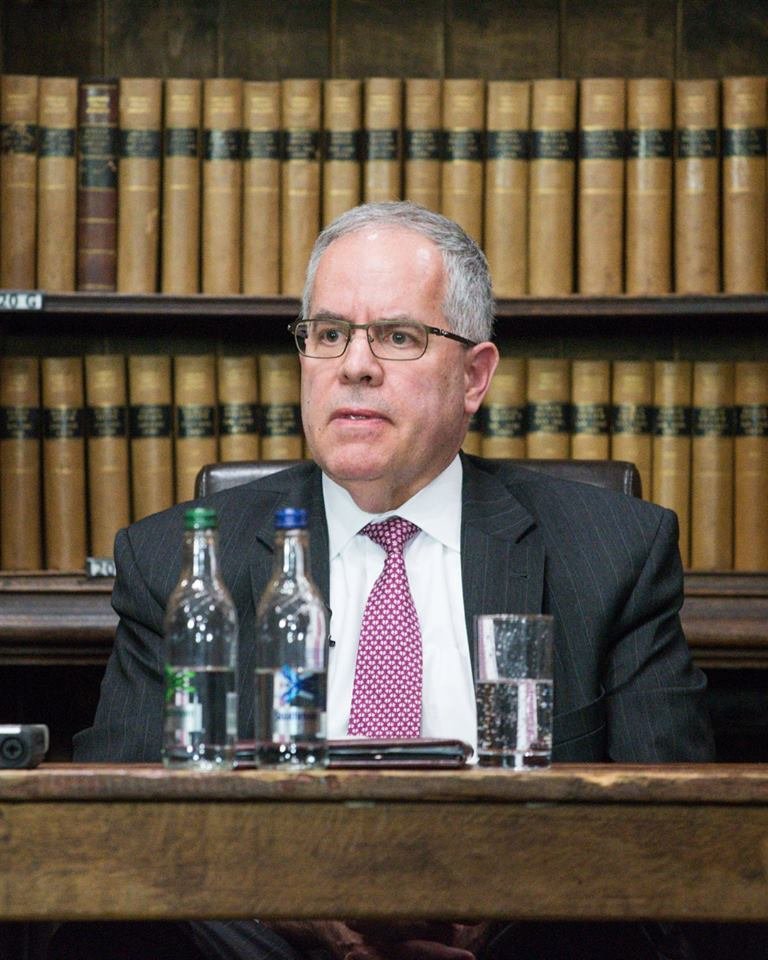
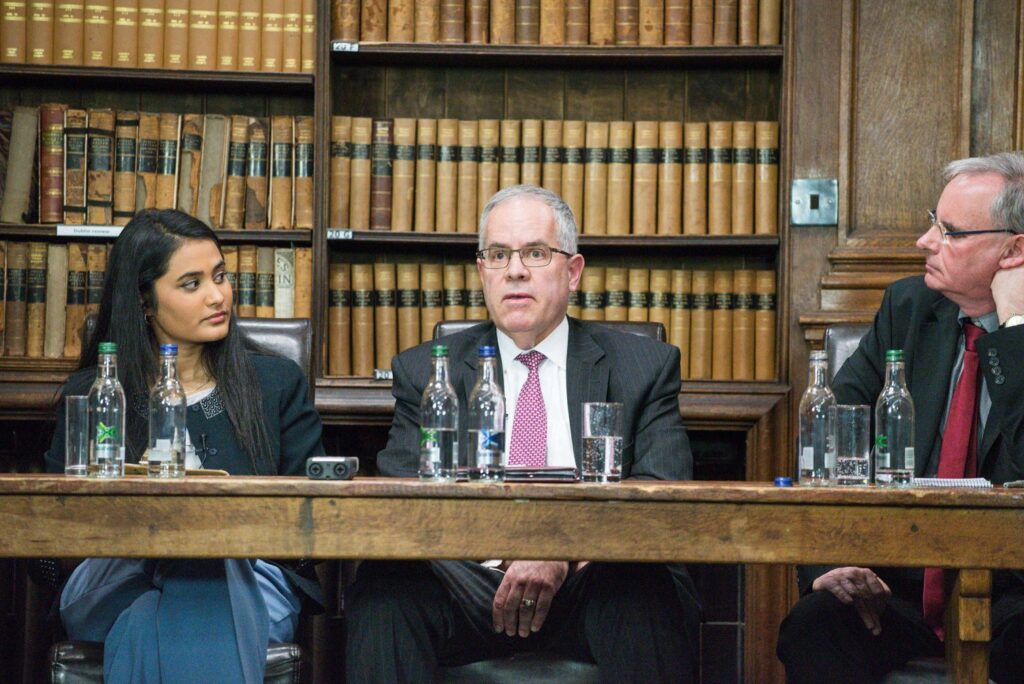
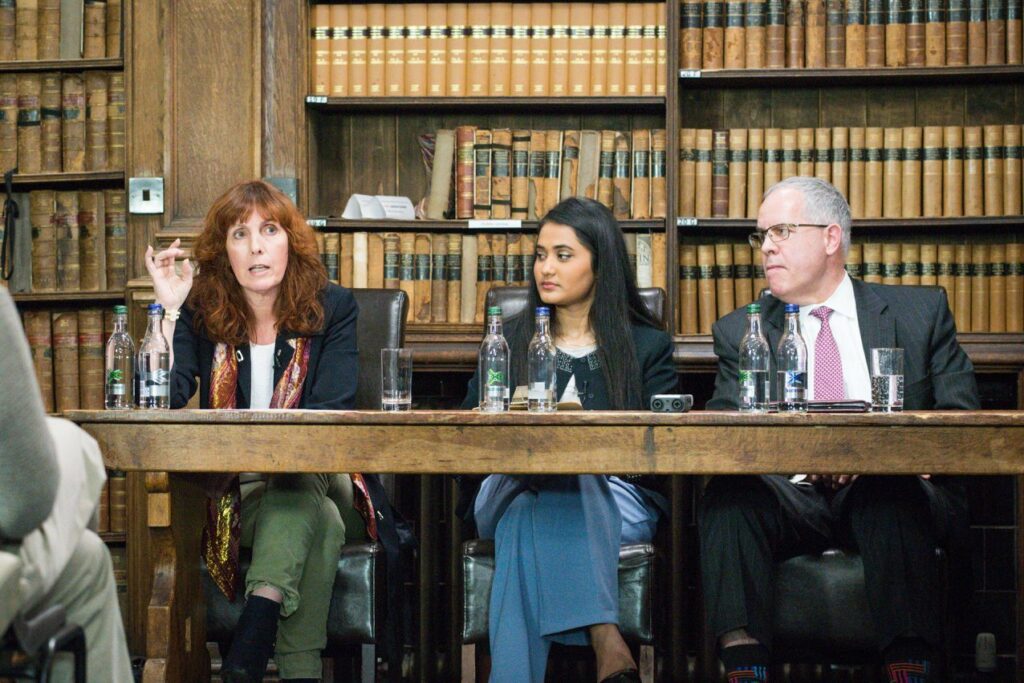
Left to right on the whistleblowing panel: Heather Marsh, moderator Laali Vadlamani, David Shedd, Ewen MacAskill
On February 27, 2018, the Oxford Union held, then censored at Shedd’s demand, a three-person panel on the very topic of whistleblowing. Here in the United States we don’t hear much about this debating society, but in the United Kingdom the Oxford Union is a huge deal: not only have Malcolm X, Winston Churchill, and additional historic figures spoken there, but over the years three of their student presidents have become U.K. prime ministers. A few months ago, one of the planet’s biggest newspapers offered the headline: How the Oxford Union created today’s ruling political class.
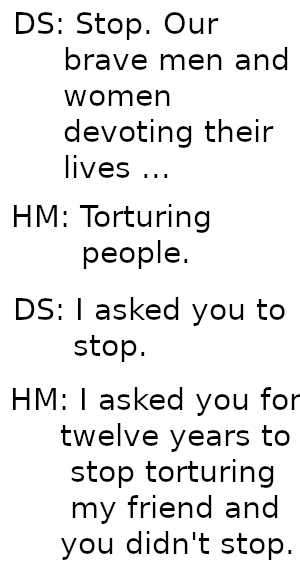
The controversial panel, held in the forum’s Goodman Library, consisted of philosopher and human rights activist Heather Marsh, longtime Guardian reporter Ewen MacAskill, and Shedd. Toward the end of the evening, the spy didn’t fare well in a back-and-forth with Marsh about torture and other subjects involving how hurting people in shadowy cages is bad actually, so with a politican’s pettiness, Shedd told the Union never to release the video recording. Marsh and her lawyers contend the Union is contractually obliged to upload the film as promised to youtube, which they’ve so far failed to do. The handful of photos they posted don’t count.
Marsh, Shedd debating during panel. Her friend is former Guantanamo Bay prisoner Omar Khadr.
A few months later, Marsh became a whistleblower herself, posting audio of her portion of the panel as well as a transcript. She wrote an accompanying analysis of the censorship, too, discussing how free speech for corporations, predators, and tyrants is shrilly upheld but the words of women and other marginalized people against the powerful are regularly shut down. When the Oxford Union bills itself as the “world’s most prestigious debating society” and the “last bastion of free speech” — then agrees to third party censorship of their own footage of a panel on whistleblowing — the society reveals its ultimate loyalty to the likes of Shedd making up the protection racket that today’s governance amounts to, where the arch-abusers run wild, occasionally promising security and belonging to the gullible who surrender their self and become obedient.
Learning of Marsh defeating Shedd, and Shedd’s subsequent censorship demand, I decided to cover the story and bought phone numbers for the his homes so I could ask him for comment. Through public records sites, personally identifiable information of just about anyone in the United States, king or streetsweeper, is available online legally in exchange for lucre. I politely called the Shedd-associated numbers, which did not include the one he texted me from. His wife — I think that’s who answered — came to the phone, but didn’t put him on the line. “Stop with the harassing phone calls!” she said, though I’d been well mannered, and though her husband had been a senior manager at a notorious worldwide purveyor of waterboarding, stress positions, sleep deprivation — you know, harassing people, to say the least.
Marsh, Shedd debating during panel. Read more about ICE.
Politely seeking comment is harassment? They clearly have an outsize sense of persecution. I simply wanted to ask him straightforward questions such as Mr Shedd, should I describe you in my article as petulant? Or do you prefer petty? How about sore loser? Anyway, my calls to his homes were the only contact I’ve ever had with Clan Shedd, and since I didn’t get ahold of the man himself, I’d never had contact with him until his weird SMS. It’s a routine thing: journalist writing article requests comment; doesn’t hear back. But more than four years later, a sudden text?
To finish up the backstory, note that while the Oxford Union student newspaper mentioned the controversy in 2018, and so did the World Socialist Web Site that same year (one; two; three; four), nobody else — besides me (with my in-depth reporting), Marsh, and social media supporters — has uttered a peep. Even Ewen MacAskill, the third panelist, has said nothing from his perch on good terms with the highly influential Guardian newspaper. Likely that’s because in the aftermath of the censorship, the Oxford Union gave MacAskill a paid lecture series to talk to audiences about, you guessed it, whistleblowing. You see, experts on whistleblowing don’t talk about censorship they know of. They keep quiet like good puppies awaiting treats. War is peace. Freedom is slavery. Ignorance is strength.
Now fast-forward to this summer, what triggered Shedd to contact me out of the blue.
Why now?
In the time frame of Shedd’s message, two things were occuring that might have prompted him to send me his strange little note.
One: Unbeknownst to me until late August, the Oxford Union in July asked Marsh to give a solo talk, something she wrote about today on her Patreon in a public post. She asked if they’d post the panel video — with Shedd blurred and muted if necessary, something they’ve done before when an individual didn’t want her performance published. In response, the Union ghosted Marsh. Presumably the debating society, following up on her question, asked Shedd if he’d change his mind, and the hierarch must have said No. And had nothing better to do than text a freelance journalist deceptively — petty and petulant and a sore loser — worrying about how all this is going to reflect on his legacy. Silverbacks like Shedd love legacy: parades, presidental libraries, pyramids. Retired and aging, he must fear the facts around February 27, 2018 will correctly tarnish his status in history. Books and articles are routinely published that trumpet Shedd (and separately, the Oxford Union), so he’s accustomed to accolades, not dissent.
Subterfuge Shedd losing debate
The other: On an ongoing basis I have for years submitted pieces to mainstream and alternative media sites that either focus on, or include, Shedd’s censorship. Revelation of the facts in a large venue would greatly help impute guilt to Shedd in the public record so he can accordingly be shunned and feel shame, unless of course his emotional processing is atrophied, which it probably is from aiding in the command of the CIA. That organization has a long history of propagandistic manipulations of the media. See for instance Watergate reporter Carl Bernstein’s 1977 Rolling Stonedeep dive on the topic addressing cover-ups of how the United States news media “worked hand in glove with the Central Intelligence Agency.” All that said — to indicate the water I’m swimming in — I have no evidence, nor even intuition, that anything illicit has happened with my freelancing, but it’s within the realm of possibility somebody at such a venue told somebody who told somebody who told somebody a freelancer named Doug is still working on winning amplification for this story, and it reached Shedd’s ears.
With the 2018 and 2022 contexts established, let’s scrutinize the spy’s missive.
Scaredy cat’s sneak attack
Good morning Ed. This is David Shedd writing from our new place in south Florida in response to your wonderful update letter. Before writing more, I want to make sure that you get this note and the text works. Warm regards, David
The message arrived at 5:20 a.m. Pacific time (I’m in Seattle). Assuming he was actually in Florida, that would be 8:20 a.m. Eastern. Pretty early to shoot off a mysterious communiqué — maybe he was in a bad mood, rising on the wrong side of the bed after earlier listening to the Oxford Union ask his permission to publish the video. Since he apparently controls them now and apparently told them No way.
I have no idea who Ed is, if anyone. In December 2020, Shedd authored an op-ed titled “Edward Snowden Should Not Get A Pardon Under Any Circumstances,” so I don’t think Shedd means him.
Shedd on the debate panel he lost
As stated above, I’d never before seen this (703) 408-2506 number, but it’s a northeastern Virginia area code where the CIA is located some ten miles from D.C. And my trusty public records services confirmed it belongs to David R. Shedd. Now I have a convenient number to call him at in case I need to request comments again. And so do you.
Regarding Shedd obtaining my phone number, maybe he paid for public records too, maybe he successfully stored my digits for over four years and put in the effort to move them to his (703) 408-2506 device, or maybe, as I documented the Austin-based private spy firm Stratfor assisting with in an unrelated but similar matter, he called a friend with access to surveillance databases and got it that way, saved himself a few bucks. He spearheaded the 2008 revisions to Executive Order 12333, which outlines when and how federal intelligence agencies may spy, so I’m sure he knows multiple ways to grab someone’s digits.
Here’s the big question. Why the deception gambit? The message asks the recipient to respond to confirm the connection is good. Why not just address me as Douglas and say … what exactly? Stop talking about me getting whopped in that debate?
Surely after more than four years, it was no mere pocket-dial or oopsident. If you’ve spent time reading leaked cables between government agents and the like, you know they pick words carefully and stamp security classifications on their papers and all that jazz. Somebody in the spy-versus-spy, backstabber-versus-backstabber world of meetings in the White House and the intelligence agencies is probably going to take his communications pretty seriously especially in light of Marsh concurrently asking the Oxford Union to release the recording.
To understand this better, let’s turn to the spy glossary created by that Austin firm Stratfor, sometimes called a “shadow CIA,” staffed with former military, former intelligence agency spooks, and an assistant to corporations in defending against activists. They define disinformation in part as “A plausible story designed to confuse the other side or to create an uncomfortable political situation.” Pinging the system means in part “Emitting information that is designed to be intercepted by the other side. Usual purpose: figure out their response patterns. Other uses, confusing the other side.” In short, subterfuge is a way of life for these people, including propaganda and manipulation of media like freelance journalists. They’re not serving the public honestly; they’re serving the shareholders and themselves; so why expect a message from a straight shooter?
My guess is Shedd, too timid to use his own name, was trying to bait me into responding, and/or stress me out: I’m watching. CIA is watching. But if you ask them for comment, they’ll just say I must have dialed the wrong number. Hahaha!
Since vanishingly few have ever published about the whistleblowing panel censorship, you have to wonder who else besides the Oxford Union Shedd is intimidating. He’s not stopping me.
David Shedd keeps losing
Such childish antics are among the activities of egregious human rights-violating hierarchs — when they’re not losing debates. Because on their side, they don’t have the truth. He prefers propaganda and fears the facts.
If Shedd’s goal was to scare me, he failed. Fragile Shedd lost again. Whatever the CIA (or Stratfor) may say, protection rackets for the highest bidders, as Marsh pointed out on the panel, aren’t security. As she said, “security is strong involved and supportive communities networked with other communities.” When I moved to Seattle in 2016, I began participating with local chapters of the Hearing Voices Network and Food Not Bombs. These egalitarian movements — and more associations with genuine activists — have afforded me close friends who, unlike many among the civilian/loyalist population, understand my work and show up to support me regularly or when something spooky happens like Shedd’s text. Protective, interlocking horizontal networks turned Shedd’s grenade into a grape bouncing off me harmlessly.
I think, somehow, one day, the whistleblowing video will be released. And then Shedd will have an opportunity to realize he’s not entitled to exceptional treatment. It’s not just his lifelong subterfuge that he tried to deploy on me. I think he’s also trying to fool himself. The longer the footage stays secret, the more easily he — and the public — can follow the head-in-sand, pro-impunity bipartisan philosophy of “look forward, not back” to avoid facing the truths Marsh (and others) have brought forward about our real legacy of torture, governance protection rackets, and so many more injustices. And the more petty and petulant Shedd’s sore loser legacy becomes.
Note: In 2020, I’m writing 52 blog posts, one per week, released on Mondays or so. Today’s short-ish post is for Week 25. I planned to just type an “oops” placeholder entry, but if you know me, then you know I can sometimes be a little…longwinded. Week 22 was my #OpDeathEaters review of the recent Investigation Discovery special focused on pedosadist Jeffrey Epstein, and Week 23 was my updating that post. Week 24 was some quick Seattle news. The upcoming longer post I referred tolast week should be up next week. Thanks for your patience!
I know a handful of white, very straight guys around the world who seem identical: roughly late thirties / early forties, recently dumped, fairly high income, lonely apartment, devoted to masculinism, to trade, to downer narcotics that are recreational, decreasingly. Often it feels nothing I ever say successfully combats the propaganda or world to which they are repeatedly exposed. Conversations with them seem like dominance battles; they keep score, and no one just shares.
Briefly, five news links from the past year and a half, to recalibrate readers who, before continuing forward, might need a reminder of the wider perspective outside the masculinist/trade/lonely life:
November 15, 2018: Article in Foreign Policy: In Russia, Feminist Memes Buy Jail Time, but Domestic Abuse Doesn’t
May 21, 2019: NBC News found that during a 5-year period under both the Obama and Trump administrations, within the system of lockup facilities recognized in 2019 by multiple Auschwitz and/or Holocaust survivors as concentration camps (Rene Lichtman; Ruth Bloch; Bernard Marks), ICE has forced thousands of immigrants into solitary confinement (recognized across the planet as a form of torture), not for breaking any rules, but for being physically disabled or gay.
May 31, 2020: My #OpDeathEaters review about Investigation Discovery’s special on Jeffrey Epstein. My review helps explain in practical and realistic terms (what actually are inquiries/tribunals?) how to stop voting for pedosadists and start arresting them.
June 2, 2020 twitter thread by Portland State University instructor Alexander Reid Ross documenting scores of violent, armed reactionary vigilantes carrying out intimidation and attacks against Black Lives Matter protests across the United States.
Today one of the masculinist-ish guys bemoaned to me this week’s efforts to topple the statue, near the White House, of Andrew Jackson, slaveowner. The person did not bemoan anything remotely on the subject of the above five news links. Yet imagine if every time the topic of toppling a slaveowner statue came up for “debate,” the conversation could not begin until first, all concentration camp victims were liberated, all femicides were prevented, all children were protected from pedosadists, all with impunity were convicted, and individuals learned to reject all bigotry.
In the face of torture and femicide and other human rights violations and unlawful killings, relentless cradle to grave propaganda trains too many USians to focus on, and endlessly talk about, rioters breaking Starbucks windows or stealing electronics from big box stores (both just ways of saying Fuck you in light of murders and more), because that tunnel vision means brainwashed USians don’t learn what much of the rest of the planet already knows: massive resistance can be far more powerful than politely giving a quiet speech about how you don’t want to be killed. To take just one example, the 2019-2020 Chileanprotests fight back against austerity and send their legislators fleeing. In other words, in a very practical and realistic move, they kicked their Congress out by force, in real life. Yet if nonstop battle by an oppressed public against powerful criminals with impunity sounds scary and sad — and I agree that it frequently is, and frequently has been throughout human history so far — then in addition, stop voting, start arresting. Practical and realistic? The South African Truth and Reconciliation Commission (which among other things publicly heard applications for limited amnesty from human rights violators) accomplished a great deal, while simultaneously having trouble enforcing subpoenas because the commissioners didn’t have enough power relative to the reactionaries in their region. Still, that the goal of justice never before achieved in full is difficult, and that previous attempts to bring justice have not yet succeeded completely, doesn’t mean quit trying and become a boring complicit and compliant coward; it means, let’s figure out improved inquiries/tribunals — now, little step by little step.
During the pandemic brought to you not by protestors (back people into a corner, what do you expect them to do, die quietly?) — see NPR and the Economist — but by super-spreaders such as Donald Trump, and this month when people are especially discussing and endorsing noncompliance/disobedience with ridiculous and unjust rules against consenting adults putting their various Tab As into their various Slot Bs proudly, while all manner of extreme wild emotions happen, to all those braver than the intelligentsia and the aspirants to the intelligentsia, to all those who read and grow and share and take informed action…
So call your US House Representative’s local and DC offices against SOPA before Thursday! ███████ politely give them a three-sentence statement: 1) Your name, your occupation (if relevant), and that you’re a constituent (give your state or ZIP code); 2) Two or so reasons explaining why you want your Representative to oppose SOPA (hurts job creation ███████ the reliable technology sector, institutes American Internet censorship not unlike China’s); 3) Say thanks ███████ re-state your point: “I want Representative So-and-so to OPPOSE the Stop Online Piracy Act.” The worker who answers will be polite to you, ███████ don’t have to worry about that.
It’s ███████ a bipartisan issue: currently, among others, notable Democrat Barbara Boxer ███████ notable Republicans Scott Brown and Eric Cantor receive lots of money from organizations opposing SOPA, and notable Republican John Boehner and notable Democrat Harry Reid receive ███████ money from organizations supporting it. So ███████ now there’s a good opening for you to contact your US House Representative as the issue’s still in play.
If you aren’t up to speed on Wikileaks news, try here and here and here, and watch this:
Now that you’re up to speed:
There is this goofy card game one of my brothers likes to play; to my knowledge, he invented it. The dealer (typically my brother!) passes out one face-down card to himself and one to each other player. At his signal, all players raise their cards to their foreheads facing out such that no one can see his or her own card, but everyone can see everybody else’s. The players then place bets as to how valuable they think their own cards are in comparison — a total guess, of course, but by this time everyone’s laughing from holding poker cards against their skin. After betting, the players reveal their cards, and the random results release laughter …
Here’s my version of the game, which so far exists only in my imagination. People find themselves seated at a dinner table, clutching their one card tightly to their chests, looking down at their stated worth — “7” or “3” or “10” — a value that is calculated according to all the good and the bad they have caused in life, according to all the secrets they know, according to all the things they wish they hadn’t said or they wish they knew how to say.
At this imaginary table of mine the players are making small talk, some of it happy, some of it sad; all are nervous about their value, and what the other players would think if their card were seen. After all, this player Sue’s card reveals that she said to this player Bob that this other, wealthy player Jorge’s a jerk, and now that Bob and Jorge are pretty good friends, does Jorge know what Sue once said about him, and if so, how does that affect who’s gonna pick up the check?
The dealer — a voice from the sky? — suggests the players lay their cards down on the table, face-up, on condition that they all, unanimously, forgive one another and love one another regardless of the cards’ value. The players agree, make their promises, and lay the cards down face-up. Angry yelling (“Jorge has the hots for both Bob and Sue?”) soon turns to laughter (“Jorge has the hots for both Bob and Sue!”) as people discover everyone’s a mess inside …
Except what if the players at the table included polarizing figures such as (take your pick) Dick Cheney, Barack Obama, Julian Assange, or heck, even that driver yesterday who cut you off when you really needed to get over a lane? Would we the powers-that-aint agree to forgive they the powers-that-be permanently if they’d lay down their cards and their guns?
I would. I would, to get the cards on the table so everyone could be safe.
There are of course several things my card-game scenario doesn’t address. For instance, it seems radical transparency and privacy can come into conflict, and privacy is I presume often preferable: if you’re surveilled to death, your creativity is chilled (partly because honest creativity requires engaging in thoughtcrime) and also under surveillance you can’t experience as fully the fun premium privacy can add to events (e.g., sweet nothings can be more meaningful when expressed without others around). Further, logically there are possible worlds where security is unjustly threatened by radical transparency, and I am uncertain as to how such situations, when they do arise in this actual world, should be handled, although I am tempted to say, well, let the chips cards fall where they may, because 4000 years of trading our rights away to leaders whose trustworthiness is unproven in return for promises of security hasn’t worked out so well.
In addition to snail–mailing Congress, I’ve telephoned elected officials (in both cases, I activist-ed in favor of a genuine public option for health care — er, health insurance reform!).
For me, calling Congress was an intimidating task at first. Maybe you know about the infamous Milgram experiment where research participants were asked to administer increasingly severe electric shocks to others — to actors pretending to be learners; the shocks were fake, but the participants didn’t know that.
Despite the screaming and the heart-pain complaints from the actors, despite the actors banging on the divider wall and pleading, most participants allowed the technician-coat experimenter to goad them into pressing not just the extreme intensity shock and Danger: Severe Shock buttons, but finally the XXX button that resulted in the actors’ silence. (Several participants laughed nervously or cried throughout; the experiment has been repeated with the same results as recently as 2009; researchers have used a real-life puppy, too, wondering if perhaps the participants figured out the shockee was an actor — no, all participants in that one killed the puppy.) Stanley Milgram explained these results in terms of conformity and fearful obedience to authority; I think whatever the reasons are, they lie behind patients’ fear of asking doctors questions (for example), and also my initial fear of phoning Congress!
Anyway. Calling Congress members became easier after I did it a few times. Aides answer (rarely do Congress members), and without exception I found them friendly, if rushed. They want you to get to the point, and you should. Though there are scripts online for various causes, I wrote out a paragraph for what I’d say, so that I wouldn’t sound like an astroturfer‘s employee. Each paragraph matched the structure of my letters: 1) who I am (including occupations & city) and what I wish from the Congress member; 2) One or at most two sentences of reasoning — including poll statistics or actual quotes from the Congress member; 3) Reiteration of what I wish from the Congress member and a friendly thank you.
And actually, unlike what might well be the case with snailmail, no aides seemed to mind when I was called from out of their members’ constituencies (I did call my own representatives at times), specifically since the issue (health reform) was national and especially when I mentioned nationwide donations (such as through ActBlue). Some aides asked for my ZIP — I’ve received a few mailings — and when the aides themselves seemed especially pleased with my perspective, I could hear it in their voices. A bad-result call ended with an aide saying, basically, “Thanks, bye”; a good-result call ended with an “I’ll be sure to pass along your comments to the Senator/Representative, thanks so much!”
Sometimes I opened with a compliment regarding something the Congress member did that I appreciated (easy to find from his or her website, or from the search strategies discussed in this post), and sometimes I simply called to say nothing more than thanks for a specific quote the Congress member gave the press or whomever; these aides and Congress members typically get angry phone calls, so it’s nice for them to receive gratitude every once in a while.
Some people went out of their way to tell me this type of activism is worthless, saying the aides’ phones must be perpetually busy. Well they’re not. I had a little trouble getting through the final day or two before the health reform legislation passed — but generally I had no trouble.
Phone numbers for elected officials can be found at USA.gov here. Definitely check out my preceding post for more stratagem. I think people neglect a whole lot of good activities — such as calling Congress — simply because the transaction costs, the totals of the effort and the irritation that must be endured to do the good deed, are too high. Activists should lower them, with info and otherwise.
I'm a Texas-born, Seattle-based freelance writer/journalist currently living in Chiapas, México. Published at Rolling Stone, Foreign Policy, Salon, WhoWhatWhy, the Texas Observer, the Daily Dot, others. I write about anything and everything, but usually current events meets investigative journalism and philosophy; liberatory mental health; education; science fiction and fantasy; technology; justice; more. Also a former public ed substitute teacher.
Email: DAL@RISEUP.NET (ask for pgp key or check keyservers if you want encryption)
Snailmail (United States Postal Service only): Douglas Lucas / PO Box 75656 / Seattle WA 98175 / United States
Snailmail (Private carriers such as UPS, Fedex, DHL, Amazon): Douglas Lucas / 11036 8th Ave NE #75656 / Seattle WA 98125 / United States
Note the single-character change in ZIP codes, between the address for USPS (98175) and the address for private carriers (98125), is not a typo.











 Twitter:
Join the conversation