Entries Tagged 'Healthcare-Reform' ↓

Digest 3

Several items in this digest are a few days old, but some are quite current, too.

  • You should read this entire New Yorker commentary on illegal immigration:

    [Illegal immigration apprehension numbers along the Arizona border] are sharply down, according to the Border Patrol — by more than sixty per cent since 2000 [...] Illegal immigration, although hard to measure, has clearly been declining. [...]

    The problem of illegal immigration isn’t a matter of violent criminals storming the walls of our peaceful towns and cities. It’s a matter of what to do about the estimated eleven million unauthorized residents who are already here. The mass-deportation fantasies of some restrictionists notwithstanding, the great majority of “illegals” are here to stay. That is a good thing, since they are, for a start, essential to large sectors of the economy, beginning with the food supply — the Department of Labor calculates that more than half the crop pickers in the United States are undocumented. National business leaders have no illusions about these basic facts of economic life.

    There are reasons to be uneasy about illegal immigration. In some industries, dirt-poor newcomers lower wages. State and local budgets suffer when workers are paid under the table. The fact that people lack legal status is itself disturbing. [...] Yet anti-immigrant backlashes don’t always track closely with actual immigration. They track with unemployment, popular anxiety, and a fear of displacement by strangers. They depend on woeful narratives of national decline, of which there is lately no shortage. Scaremongering works. [...]

    Projections show white Americans becoming a USA demographic minority in the 2040s. Anyone got an idea what, with present voting trends, that’d do to current Republicans? I think that has a lot to do with the rightwing’s anti-illegal immigration position.

  • At Boing Boing, Cory Doctorow mentions a £1,000-prize fiction-writing contest that insisted, for the alleged betterment of humankind, that contestants handwrite their entries and avoid science fiction. Nobody entered the contest.

  • INCEPTION’s tangled plot conflicts Nancy Kress:

    INCEPTION is, in microcosm, the state of much current [science fiction]. It is so complex and self-referential that much time is spent figuring out what is happening, rather than inhabiting what is happening. Is this good or bad? I guess that depends why you like stories. [...] If you want them to be reflections of human experience, then INCEPTION is still good but not as good as it could have been [...] judging from the enthusiastic audience reaction last night, puzzles are what is wanted. People applauded at the end.

    Kate and I haven’t seen it yet. Despite Roger Ebert and William Gibson complimenting the movie — those two would make a great movie-reviewing duo — we might not get around to seeing this one at all. And, I have to say that right now I’m really enjoying the Kress novel Beggars in Spain.

  • The NYT praises health reform implementation thus far.

  • The Washington Post publishes its two-year project exposing the Top Secret America surveillance and intelligence industry. In case you’ve forgotten about it, here’s the Fourth Amendment:

    The right of the people to be secure in their persons, houses, papers, and effects, against unreasonable searches and seizures, shall not be violated, and no Warrants shall issue, but upon probable cause, supported by Oath or affirmation, and particularly describing the place to be searched, and the persons or things to be seized.

  • Literary agent Nathan Bransford with his top 10 myths about our eBook future.

  • Sleepwalking woman on Ambien sends emails about her dreams — Discover Magazine can haz it, or the protagonist from INCEPTION can, I guess.

  • New interview with Ted Chiang, spear-famed writer of quite brainy science fiction:

    I started submitting stories for publication when I was about 15, but it was many years before I sold anything. I don’t make my living writing science fiction so in that sense I’m still not a pro. Writing for publication was always my goal, but making a living writing science fiction wasn’t. [...]

    Science fiction is very well suited to asking philosophical questions; questions about the nature of reality, what it means to be human, how do we know the things that we think we know. When philosophers propose thought experiments as a way of analyzing certain questions, their thought experiments often sound a lot like science fiction.

    Buy his short story collection!

  • My Clarion West ’08 classmate Carlton Mellick III and the rest of the Bizarro writer army make The Guardian and Boing Boing. Carlton was a fun guy, extremely talented, and extremely sincere in a way that was still informed — not dewy-eyed.

  • A Boing Boing post discusses The Bechdel Test, a few quick questions that help evaluate the representation of women in any movie.

  • At GalleyCat, novelist Bret Easton Ellis says writers will make more money due to eBooks, not less, in part because of the decreased costs of producton allowing for higher royalties.

Done!

Campaign to snailmail all 535 United States Congresspeople to ask for a genuine public option

I hereby announce my campaign to snailmail all 535 United States Congresspeople personalized letters before the year is out, in favor of a genuine, government-run public option. So far I’ve snailmailed 4; 531 to go.

Image: Timothy Morgan

(Image: Timothy Morgan)

Here’s sufficient info to learn how to snailmail members of the US Congress, regardless of what your stance is on whatever issue. Here’s a frequently-updated priority list of which US Congresspeople to contact in favor of a genuine public option, though you of course might choose others to write.

Maybe you doubt the efficacy of writing US Congresspeople. I understand, especially when, for instance, the pharmaceutical and health product industries lobbied the US Congress $1.2 million per day in the first three months of 2009 (not counting advertising & other efforts, including whatever’s under-the-table). Despite much information to the contrary, citizen snailmail (especially when personalized) does reach US Congresspeople, or at least their staff, without too much delay. Evidence:


  • In 2009 The Washington Post persuasively reported a professional lobbyist firm snailmailed astroturfed (fake grassroots) letters to US Representative Tom Perriello. So if they expect fake letters to work, you should expect real letters to work. I can’t resist mentioning Shakespeare: as the New York Times put it, “Generated mail is a pretty old idea. In Shakespeare’s ‘Julius Caesar,’ Brutus is persuaded to assassinate Caesar in part by letters of support from the public — letters that were actually faked by Cassius ‘in several hands … as if they came from several citizens.’”

  • On 10 Sept 2006, The Pottsville Republican & Evening Herald published a story about a 10-year-old girl, Taryn Kitchenman, who wrote US Representative T. Timothy Holden a letter. She wrote him: “I was wondering instead of putting [the new playground] downtown right by the old one, could you put it in Arnots [her neighborhood]. I was wondering because we only have one playground and it is not that good. We don’t have swings, we don’t have a good basketball court. I am only 10, I am not allowed downtown. Try and help me.” She received a reply the same week. Presumably this was a snailmail letter (and not fax or email “letter”).

To prove that I’m serious about my campaign, below I’ll post the letter I sent US Representative Nancy Pelosi yesterday. In an attempt to protect myself against discrimination and stigmatization, I censored out a very small portion of the letter, though presumably the letter is now public record somewhere. I’ve also PDF’ed the letter so you can see the formatting in case you want a guide for your own snailmail. Because you’re going to write your own personalized letter(s) — or do something equivalent or better — right?

Douglas Lucas
[street address]
Fort Worth, TX 76109
[email address]

The Honorable Nancy Pelosi
Office of the Speaker
H-232, US Capitol
Washington, DC 20515

16 September 2009

Dear Representative:

I’m writing to support your insistence that a healthcare reform “bill without a strong public option will not pass the House” (your Press Release, 3 Sept. 2009), to agree with your statement that if “a vigorous public option is not included, it would be a major victory for the health insurance industry” (your Press Release, 3 Sept. 2009), to ask you to continue to insist on a strong, government-run public option — which, as you know, does not mean a co-op plan such as that of Senator Max Baucus — and to ask you to fight any spin attempting to pass off a co-op plan as a “public option.” I’m a self-employed writer and tutor in Fort Worth, Texas, and, just out of college, I’m working toward a public-school teaching certification. Like many Americans, I have a pre-existing condition — in my case, [type of pre-existing condition]. I lose my BC/BS disability coverage in February.

My medicine for this one illness alone costs nearly $1000 per month. Without reliable health insurance, I cannot responsibly teach public school. Sure, a school would provide me with group coverage, but what if I were laid off? COBRA only goes so far; high-risk pools only go so far. Just as you chose a career in civil service to help others, so I want to help others, and a government-run public option would give me a strong safety net so I could focus on teaching. A co-op plan wouldn’t have the membership clout needed to compete with private insurance. The Iowa state government tried a nonprofit co-op — and it died in two years (New York Times, 17 Aug 2009). Just like a trigger plan, a co-op plan would take longer to start than a government-run plan, and we don’t have any more time. According to a 2007 American Journal of Medicine study, an American family files for bankruptcy in the aftermath of an illness every 30 seconds. In 2009 the Center for American Progress explained that every day, 14,000 Americans lose their health insurance: 2,190 in your state, 470 in mine. Every day. It is a moral issue.

Thank you for fighting in favor of a strong, government-run public option. Please keep fighting.

Sincerely,

[hand signature]

Douglas Lucas
Can I Have Some Healthcare Reform Democracy Please

The public option, says the Chicago Tribune in 2009, is a “government-sponsored insurance policy [that] would be offered alongside private plans.” It’s a Medicare-like option American citizens could select voluntarily if they so desired, and that taxed American citizens would pay for, as they already pay for other public goods/services ranging from air traffic control to zoos.

In an effort to take some of the right-wing food coloring out of the swimming pool, here’s some information, as opposed to dis-information. By itself, the information below doesn’t prove the public option a good thing (though the public option is a good thing). But it does make you sigh and wonder where the hell the (representational, constitutional) United States democracy has gone off to. Here’s a hint about some of the above-the-table answers.

If you hate the public option but still want a lesson out of this, it’s that you should look at primary sources as much as possible when learning stuff. Preliminary research seems to indicate teens today, for example, have practically no media literacy training and typically don’t think about sources’ credibility.  Finally, you should watch President Obama’s speech about healthcare reform tomorrow (Wednesday September 9th), which might change the ballgame quite a bit.

N.B. The information below is subject to irrelevancy as time marches on.

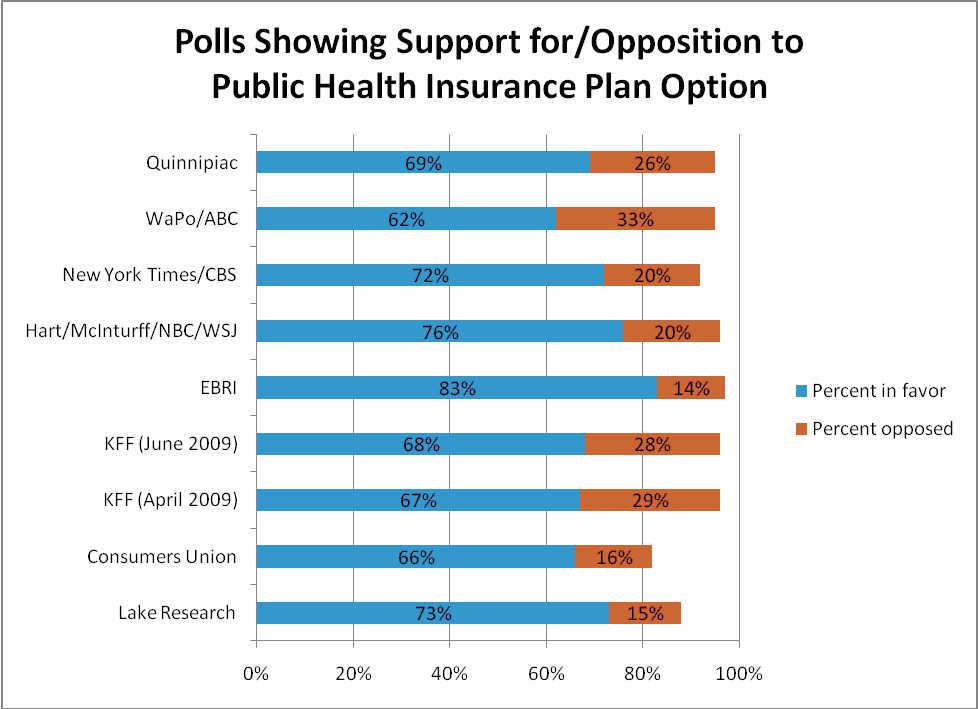
Click the graph below to see that the American citizenry definitely supports the public option. Sources: Quinnepac (July); Washington Post / ABC (June); New York Times / CBS (June); Wall Street Journal / NBC (June); if you want the others, you could start by looking at the source information near the bottom of this page.

Americans support public option

A supposedly Chinese curse says, “May you live in interesting times.”